



U.S. Central Command said it launched additional strikes against Iran on Saturday, a further test of the fragile ceasefire agreement signed by both countries.
Limited time: Save 25% on NBC News subscription
Get exclusive reporting, live Q&As and ad-free reading.

The latest flare-up of tensions, just a week on from the signing of a memorandum of understanding intended to start the process of bringing the conflict to a close, began Thursday when Iran struck a ship transiting the Strait of Hormuz.
The U.S. launched retaliatory strikes on Friday, accusing Iran of violating the ceasefire agreement. The Pentagon said its Friday strikes were “in direct response” to Iran’s “aggression against commercial shipping.” It said that after the strikes, “Iran was given a chance to honor the ceasefire agreement but elected not to.”
A statement Saturday said Iran responded by hitting “targets linked to the American aggressor forces” in the region, criticizing Gulf states whose territory has been used “to carry out hostile actions against the Islamic Republic of Iran.”
On Saturday evening, U.S. Central Command launched another wave a retaliatory strikes, saying it attacked multiple targets in Iran at President Donald Trump’s direction.
Trump said in a Truth Social post Saturday evening that U.S. aircraft struck Iranian missile and drone storage locations and coastal radar sites “for violating the Cease Fire Agreement, AGAIN!”
The president threatened that if Iran doesn’t “learn,” the U.S. “will be forced to militarily complete the job that we successfully started” and that “the Islamic Republic of Iran will no longer exist!”
No specific target was identified in Iran’s strikes earlier Saturday, but Bahrain, which hosts the U.S. Navy’s 5th Fleet, later condemned what it said was an Iranian drone attack on its territory, calling the strike a flagrant violation of its sovereignty and “a blatant threat to the security of its citizens and residents.”
Iran, which had been angered by ships transiting through the strait outside of a route through Iranian waters specified by Tehran, shot at least four drones at ships traveling through the strait on Thursday, Trump said on Truth Social Friday morning. One of those hit the upper deck of a cargo-carrying ship, and the U.S. “knocked down” the three other drones, he said.
The ship that was struck was the M/V Ever Lovely, a Singapore-flagged cargo ship exiting the Strait of Hormuz along the Omani coast, according to U.S. Central Command. There were no injuries, and the ship remained operational despite some damage, according to the shipping company and Singaporean port officials.
“Obviously, this is a foolish violation of our Ceasefire Agreement,” Trump said.
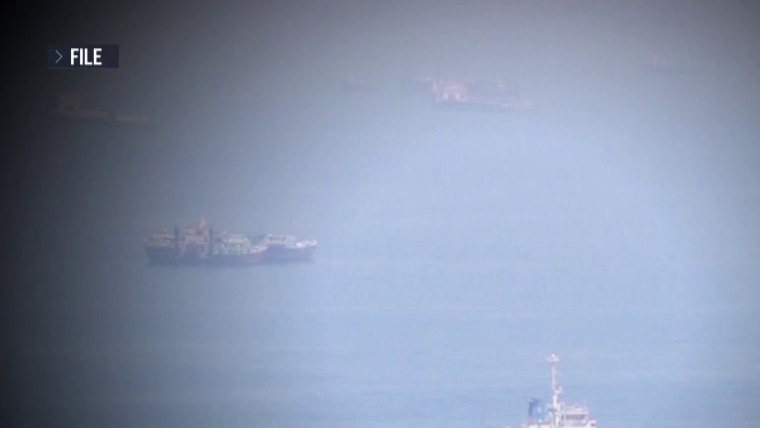
“The unwarranted aggression against commercial shipping by Iranian forces clearly violated the ceasefire,” Central Command said Friday. “Furthermore, Iran’s dangerous behavior undermined freedom of navigation as commerce increasingly flows through the vital international trade corridor.”
On both sides, tempers have frayed over the latest exchanges. “The U.S. attacked Iran in the middle of negotiations once again,” Ebrahim Azizi, head of the national security commission of the parliament, said on X. “The failed U.S. President has shown he has no commitment to the principles of negotiation or a ceasefire.”
Iran also accused the U.S. of violating Article 1 of the memorandum of understanding, which calls for “the permanent termination of military operations on all fronts, including in Lebanon.”
Limited fighting has continued between Israeli forces and the Iranian-backed Hezbollah in southern Lebanon, despite multiple attempts to broker a ceasefire. A fresh agreement between Israel and Lebanon was signed in the U.S. on Friday.
Mohsen Rezaei, a senior official and former commander of the Iran Revolutionary Guard Corps, said the U.S., through its support of Israel, had violated the deal.
“The response to the violation of any article of the memorandum of understanding will be swift and decisive,” he said on X.
Vice President JD Vance, who has been tapped to play a lead role in ongoing U.S.-Israel negotiations, said Friday on X: “If they have disagreements about how the MOU is being applied, they can pick up the phone. But violence will be met with violence.”
The memorandum of understanding was signed just last week, and stipulates that the Strait of Hormuz — a vital waterway through which some 20% of the world’s oil passed before the war — will reopen and that Iran agrees to allow safe passage of commercial vessels with no charge for 60 days.
The strait has been a point of contention between the U.S. and Iran in the war, with Iran seeking to maintain leverage over the waterway, and American and global officials insisting transit should be free. Instead of following Tehran’s specified route through the strait, some vessels have been traversing along a route that avoids Iranian waters and instead hugs the coastline of the United Arab Emirates and bends along Oman’s Musandam Peninsula.
The International Maritime Organization (IMO), the U.N.’s maritime agency, had coordinated the alternative route but has since paused its efforts. Arsenio Dominguez, the IMO’s secretary general, said the vessel struck Thursday “did not transit under IMO’s evacuation framework.”
The UKMTO said Saturday that it had raised the threat level in the strait to “substantial” following Thursday’s attacks.
“Mariners are advised of the existence of mines and should expect naval presence as clearance operations continue,” it said on X.
Iran has previously warned that it cannot guarantee safety for ships that are not following a specified route close to the Iranian coastline.
Iran’s Islamic Revolutionary Guard Corps stressed Friday that under the memorandum Iran is to be responsible for arrangements on navigation of the Strait of Hormuz.
“America by provoking different parties, sought to violate this commitment and the necessary response was given and will continue in the future,” the IRGC said, according to semi-official Iranian news agency Mehr News.
“In case of repeated aggression, our response will be broader than this,” it said.

