


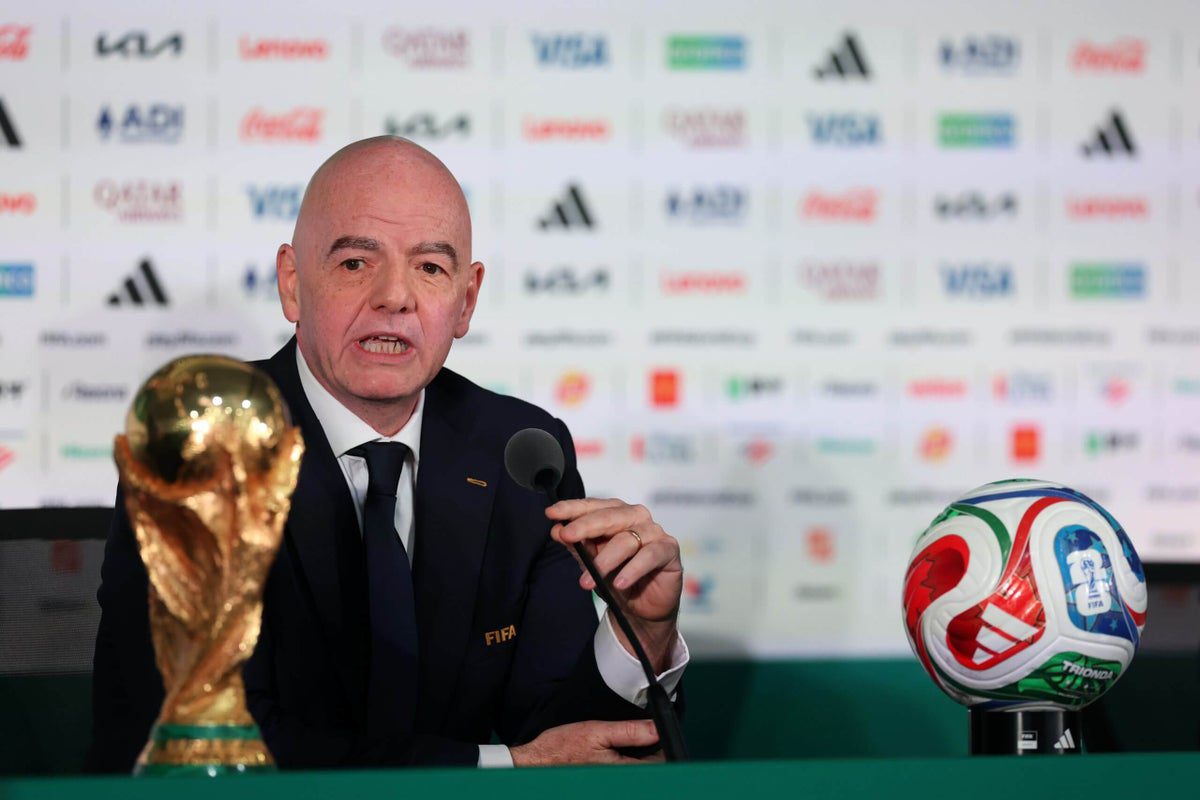
European nations have agreed to boycott the World Cup over FIFA’s plans to sell stakes in the tournament to private investors.
The decision to boycott any competition run by FIFA was taken at a virtual meeting of the 55 national associations which are members of UEFA, the European football confederation, on Thursday, according to sources with knowledge of the meeting. That followed news of FIFA’s proposal on Tuesday, with world football’s governing body telling its 211 member associations that the plan needed to be approved by September 19.
UEFA later confirmed its stance, with the organisation saying it and its members “unanimously and unequivocally reject FIFA’s proposal to transfer ownership interests in the World Cup and other FIFA competitions to private investors.
“As a result of today’s discussion, no UEFA national teams will participate in any FIFA competition for so long as these proposals remain alive, unless this proposal has been abandoned in its entirety and binding assurances have been given that FIFA will never again open its governance or competitions to private ownership.”
The next World Cup in the calendar is the women’s edition in Brazil in 2027, followed by the men’s tournament in Spain, Portugal and Morocco in 2030. Women’s World Cup qualifiers, which are organised by each continental confederation, are due to begin in October.
Concacaf, the soccer confederation of North, Central America and the Caribbean, says it rejects FIFA’s plans to sell stakes in the World Cup to private investors.
All 41 members of Concacaf met on Thursday to discuss the proposals.
One source with knowledge of the meeting, speaking on the condition of anonymity to protect relationships, said the feeling and discussion expressed among the vast majority of Concacaf members was that they are losing confidence, or have lost confidence altogether in Gianni Infantino as FIFA President.
What are the new plans?
On Tuesday, FIFA confirmed its proposal to sell a significant minority stake in a new entity that it, as a non-profit organisation, is setting up to run its main events, such as the World Cups and Club World Cups.
This new entity will be called FIFA Forward Enterprises (FFE) and will take over FIFA’s commercial operations, with the organisation itself remaining soccer’s global governing body and retaining a majority stake in FFE. A press release from FIFA said it was seeking to sell up to 21 per cent of FFE, aiming to bring in $4.2billion (£3.2bn). That money could be immediately released to its member associations.
This proposal must be approved by the majority of FIFA’s 211 member associations — including the English FA, U.S. Soccer and the Royal Spanish Football Federation — and the FIFA Council, the organisation’s decision-making arm made up of the FIFA president, Gianni Infantino, its eight vice presidents and 28 other members. FIFA said on Tuesday this must be done by September 19, in order for funds to become available for its member associations by the start of 2027.
Infantino has spearheaded the idea, and said in the release that “football is the world’s most popular sport and an extraordinary engine of human and social development.”
“Parts of the game have turned that popularity into remarkable commercial value — and we celebrate that success and want it to continue, because it lifts the whole game,” he said. “Our job is to make sure the rest of football grows with it: FIFA exists to support sustainable, inclusive development in every corner of the world.”
On Friday, FIFA added it “acknowledges and respects feedback and concern aired in public” but was pressing on with its proposals, adding that the body “reaffirms its commitment to an open and democratic consultation”.
It said FFE “has been proposed solely to ensure that all FIFA Member Associations (MAs) have the opportunity to take meaningful ownership of the commercial opportunity of football in their respective countries, and that this does not come at the cost of either the spirit or the governance of FIFA or football itself.”
It added: “Nobody is selling football. This is not something FIFA would ever entertain.
“Everyone has the right to express their opposition and to seek further clarification but no single entity can claim to represent all 211 MAs around the world.”
‘So long as Europe has a voice, the World Cup will never be for sale’
UEFA’s 470-word statement strongly condemned FIFA’s idea.
“The World Cup cannot be treated as an investment product,” it said. “It is one of football’s greatest sporting legacies. It has been built over generations by players, national teams and supporters across every continent. No part of it should ever be surrendered to private investors. The World Cup is not for sale.
“The moment external investors acquire ownership interests in FIFA competitions, football changes forever. Commercial return becomes a permanent obligation. Investor expectations become a daily pressure. From that moment onwards, every decision on the international calendar, every decision on competition formats and every decision shaping the future of football is no longer driven by what best serves the game, but by what best serves shareholders.
“This model has no place in world football. Football’s future cannot be dictated by the expectations of those whose first duty is to maximise financial return. Nor can the interests of national associations, leagues, clubs, players and supporters become subordinate to investor returns. Football cannot mortgage its future for financial gain.
“Europe’s position is clear. We will never lend this model our legitimacy. No one has the moral authority to sell what they merely hold in trust for the next generation.”
Are FIFA really trying to sell the World Cup? An expert explains
Chris Weatherspoon
“There are moments when institutions are judged not by what they are prepared to accept, but by what they refuse to compromise,” the statement continued. “This is one of those moments.
“Some things are simply too important to sell. The FIFA World Cup belongs to football. It always will. And so long as Europe has a voice, it will never be for sale.”

UEFA is made up of 55 member associations and led by its president, Aleksander Ceferin (Pedrag Milosavljevic/AFP via Getty Images)
UEFA was also critical of how FIFA’s proposal came to light, firstly through a report in the Times of London and then in a press release from world football’s governing body: “It is both irresponsible and indefensible that a proposal of such significance for football was conceived in secret and brought to the brink of approval without any meaningful consultation with those entrusted with stewarding the game.
“This is not merely a profound failure of leadership, but an abdication of FIFA’s duty as the custodian of world football. National associations around the world are now presented with an ultimatum: accept the irreversible capture of football’s greatest competitions or bear the consequences. This is not a ‘democratic decision’, but governance by intimidation — an act of coercion unworthy of an institution entrusted with the stewardship of the global game.”
How the rest of the world reacted
UEFA’s public message was quickly followed by statements from several of its member associations, including Norway — which has often been critical of FIFA and Infantino — England, Scotland and Wales.
On Tuesday, FIFA’s plans were met with backlash. Infantino’s predecessor Sepp Blatter and UK Prime Minister Andy Burnham were among the critics, while UEFA said the proposal “crosses a line that football’s governing institutions should never cross.”
Other continental confederations, though, appeared to initially take more issue with the process FIFA had followed. This included Concacaf, which accused FIFA of a lack of consultation regarding the proposals.
“Concacaf was only made aware of this matter through media reports and, subsequently, via a media release,” a statement read. “We are deeply concerned by the lack of due process.”
The Asian confederation also said it was “disappointed that a matter of such significance entered the public domain before the AFC family had been afforded the opportunity to examine and discuss it through the appropriate and established governance channels.”
The African confederation, however, only commented to confirm its involvement in the consulting process, “encourag(ing) its Member Associations to examine” the proposals themselves.
Infantino subsequently defended the idea on Wednesday in an interview with FIFA, the organisation he leads. In a five-minute video, he said it was a “democratic process” and “strengthening the commercial side of the game is the natural next step in (FIFA’s) evolution.”

