


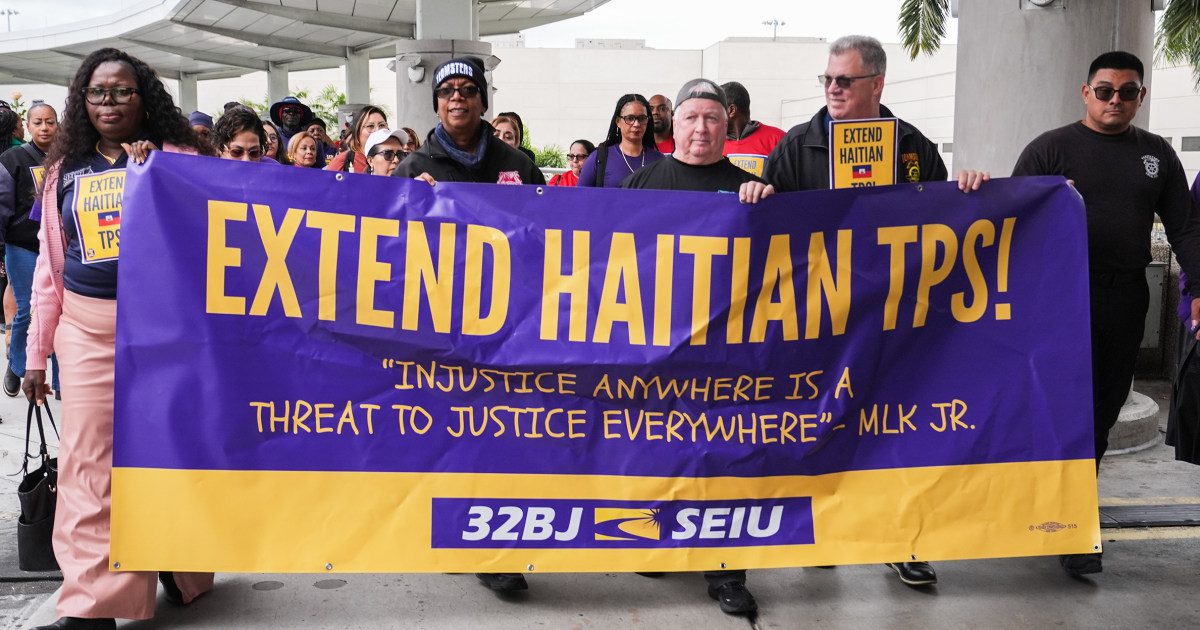
WASHINGTON — The Supreme Court on Thursday cleared the way for the Trump administration to remove legal protections from thousands of Haitian and Syrian immigrants in the United States, meaning they could be subject to deportation.
Limited time: Save 25% on NBC News subscription
Get exclusive reporting, live Q&As and ad-free reading.

The court, on a 6-3 vote on ideological lines, ruled in favor of the administration, which asked to continue with its plan to strip Temporary Protected Status from about 350,000 Haitians and 6,000 Syrians.
Writing for the majority, conservative Justice Samuel Alito said that judges overstepped their authority in second-guessing the administration’s decision. The court also rejected a claim that the decision to remove protections for Haitians was discriminatory.
The law in question “expressly restricts” courts from reviewing determinations made by the Department of Homeland Security on whether to terminate or extend TPS protections, he wrote.
As for the claims of discrimination against Haitians, Alito said none of the statements cited by plaintiffs — including President Donald Trump baselessly accusing them of eating people’s pets — were “overtly racial” and “insufficient to show that the termination of Haiti’s TPS designation was based on the race of the Haitian people.”
Geoff Pipoly and Andy Tauber, who were lead counsel in the case before the Supreme Court, said in a statement that “simply put, the Supreme Court’s ruling will directly result in thousands of innocent people dying violent, needless deaths.”
“This decision will endanger Haitian TPS holders who fled their homeland in pursuit of what generations of immigrants yearned for when they made the painful decision to leave all they have known: to live in safety,” they said.
Dahlia Doe, a Syrian TPS recipient and lead plaintiff in the case said “today’s decision is a devastating blow to me and thousands of TPS holders and our families who built our lives in this country in good faith.”
“We are real people whose futures now hang in the balance. This is not simply a legal outcome, for us it is the loss of stability, the fear of separation from our families, and the uncertainty of what comes next,” she said in a statement. “We are parents, workers, students, caregivers, and neighbors, and despite this disappointing decision, our contributions and our humanity remain unchanged.”
Last year, the Supreme Court in two separate decisions allowed the Trump administration to revoke the same kind of legal status from 600,000 Venezuelans in the U.S. The Trump administration argued in court papers that those actions set a precedent that lower courts should have applied to the Haitian and Syrian immigrants, too.
Solicitor General D. John Sauer, arguing for the government, wrote that former Homeland Security Secretary Kristi Noem’s decisions on revoking TPS designations are not reviewable in court.
The TPS program, in place since 1990, provides humanitarian relief to people from countries reeling from war, natural disasters or other catastrophes. Recipients have legal status in the U.S. and can apply for work authorization for up to 18 months, subject to extensions.
Noem concluded that Haiti and Syria no longer met any of the conditions for legal status, saying conditions in both countries have improved.
The State Department currently tells Americans not to travel to either country, with both included on its “do not travel” list.
“Haiti has been under a State of Emergency since March 2024. Crimes involving firearms are common in Haiti. They include robbery, carjackings, sexual assault, and kidnappings for ransom,” the State Department says regarding Haiti.
“This ruling is a devastating betrayal of Haitian families who have lived, worked, and contributed to this country for years — only to be cast out based on anti-Black immigration sentiment,” Derrick Johnson, president and CEO of the NAACP, said in a statement following the court’s decision. “The Supreme Court has given the green light to deport over 350,000 people, jeopardizing their safety, all while ignoring clear equal protection principles. It’s a shame that this is the America we’ve come to be.”
As for Syria, the department says that “no part of Syria is safe from violence.”
Krish O’Mara Vignarajah, president and CEO of the advocacy group Global Refuge, said “this is a deeply painful day for hundreds of thousands of families who have built their lives here lawfully, paid taxes, cared for our communities, and who now face the prospect of losing everything.”
“Importantly, the Court did not find that Haiti or Syria is safe. It found that the question is beyond the reach of judicial review,” she said. “Our immediate concern is what happens to these families and children should they be forced back to the dire circumstances that have long prevented their safe return. However, the larger question is whether there remains any meaningful oversight when decisions of this magnitude are made without an honest accounting of conditions on the ground.”
Without protected status, affected people are subject to deportation via the normal legal process. But they can seek other avenues for remaining in the U.S. by, for example, claiming asylum.
In the Haiti case, a group of TPS holders alleged that Noem’s decision was not, as she claimed, based on a serious assessment that Haiti is now safe for people to return.
A Washington-based judge concluded in February that Noem had failed to follow the correct procedures in terminating TPS for Haiti and said there was evidence the decision was based on “anti-black and anti-Haitian animus.”
The judge pointed, among other things, to an X post from December in which Noem, referring to immigrants in general, said: “WE DON’T WANT THEM. NOT ONE,” as well as Trump’s 2018 statement that Haiti is a “shithole country.”
Even while the case has been pending at the Supreme Court, the plaintiffs have alleged that further evidence has come to light, saying in a court filing that the government “relied on a knowingly false statement” that Noem had consulted with the State Department, when in fact she had not.
In the other case, a federal judge in New York ruled in November in favor of seven Syrians who either already received legal status under the program or have applied for it.
In both cases, appeals courts declined to put the lower court decisions on hold.
In urging the court not to intervene, lawyers representing the Haitian challengers said people would “risk death” if sent back to Haiti. They also pointed to comments made by Trump during the 2024 election, baselessly claiming that Haitians in Springfield, Ohio, were eating people’s pets as evidence of alleged racial bias.
Lawyers for the Syrian plaintiffs invoked the current war in neighboring Iran in arguing that conditions in the region are unsafe and questioned why the Trump administration had filed with the court on an emergency basis, seeking such an urgent decision, when some Syrians with TPS have lived in the U.S. for more than a decade.
The Trump administration has also withdrawn TPS status from people from other countries, including Afghanistan and Cameroon. As of March 2025, about 1.3 million people from 17 countries had TPS, according to the National Immigration Forum, an immigrant advocacy group.
In a separate move taken as part of Trump’s hard-line immigration policy, which was also allowed to go into effect by the Supreme Court last year, the administration terminated a Biden-era program that allowed more than 500,000 immigrants from four other countries — Cuba, Haiti, Nicaragua and Venezuela — to remain in the U.S. while their claims were adjudicated.

