


The likelihood of a potentially powerful El Niño taking shape in the Pacific Ocean is rising, heightening concerns that Southern California could be in for an extreme rainy season.
There is now an 82% chance that El Niño is likely to emerge over the next few months, up from the 61% chance estimated a month ago. And there’s now a 96% chance that the climate pattern — characterized by warmer ocean waters in the central and eastern tropical Pacific — will be in force this winter, the National Weather Service’s Climate Prediction Center said Thursday.
It remains to be seen how strong this iteration of El Niño could be. There’s up to a 37% chance that it will be “very strong” by the end of the year, up from a forecast of 25% issued last month.
There’s also a 30% chance El Niño will be “strong,” a 22% chance it’ll be “moderate,” and a 9% chance it’ll be “weak,” forecasters said.
“The tropics are changing quickly, so we have increasing confidence that we will transition to El Niño within the next couple of months — and also a higher likelihood that this event may be a strong event by this coming fall,” Nathaniel Johnson, meteorologist with the National Oceanic and Atmospheric Administration’s Geophysical Fluid Dynamics Laboratory, said in an interview Thursday.
Climate scientist Zachary Labe, of the nonprofit Climate Central, said that “clearly, an El Niño is coming our way.”
“This is really indicating that we are headed for potentially a very rare and unusual El Niño event this year,” Labe, formerly of the Geophysical Fluid Dynamics Laboratory, said during a briefing Thursday.

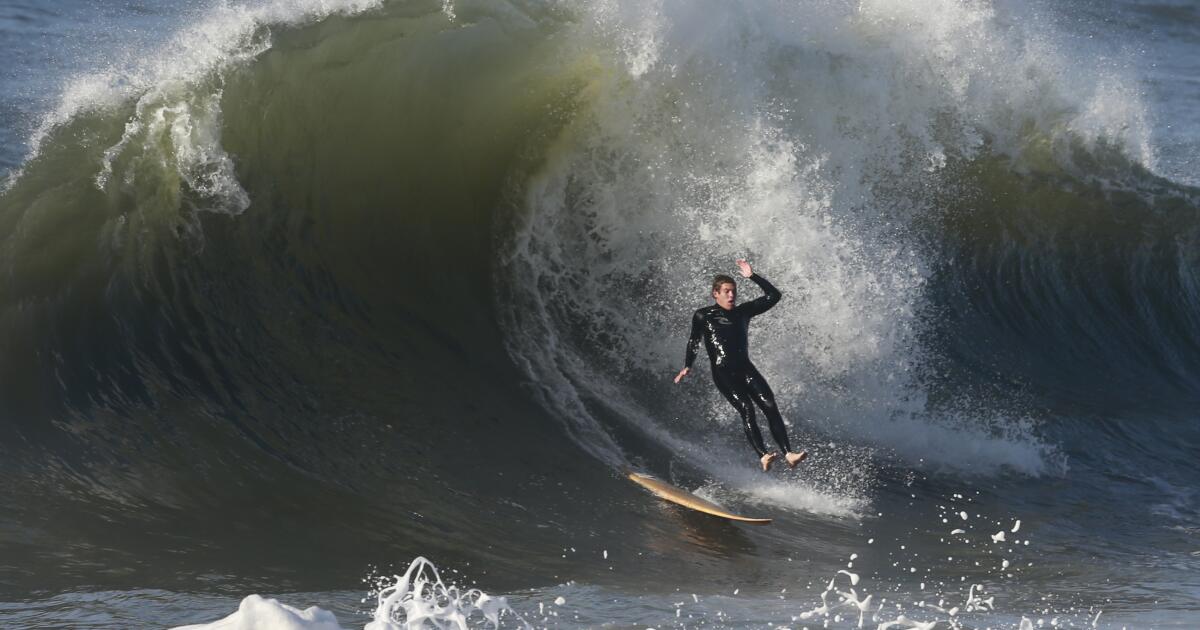
(Paul Duginski / Los Angeles Times)
El Niño is one of the most powerful climate patterns on Earth, capable of reshaping global weather and affecting rainfall and drought, according to the World Meteorological Organization. It typically hits every two to seven years and lasts around nine to 12 months.
A typical El Niño is linked with higher-than-average precipitation in Southern California, according to the National Weather Service. A strong El Niño can shift a subtropical jet stream that normally pours rain over the jungles of southern Mexico and Central America toward California and the southern United States.
Global temperatures are already rising due to human-caused climate change, but “what an El Niño can do is it can temporarily boost global temperatures,” Labe said. California has already smashed through a series of heat records with increasing regularity, including earlier this year — notching the hottest March ever recorded. It was also the hottest March for nine other states, and the contiguous United States.
While it’s no given that El Niño will bring a potent rain season to Southern California, some previously high-powered patterns have been monsters.
There have been only three “very strong” El Niños in the past half-century, in 1982-83, 1997-98 and 2015-16. The first two brought huge and destructive amounts of precipitation to the Golden State.
In early 1998, storms brought widespread flooding and mudslides, causing 17 deaths and more than half a billion dollars of damage in California. Downtown L.A. got nearly a year’s worth of rain in just one month. At least 27 homes were so severely damaged that they could not be safely occupied along the coast, according to the California Coastal Commission.
During the winter of 1982-83, damage was particularly severe along the coast as high tides surged amid powerful storms. About $100 million in damage was reported. The U.S. Army Corps of Engineers reported 33 oceanfront homes were destroyed and another 3,000 houses, as well as 900 coastal businesses, were damaged by storm surges, waves, erosion and other forces.
But the 2015-16 El Niño — while strong in the equatorial Pacific — didn’t bring the anticipated rainfall effects to Southern California, and failed to snap the state out of a punishing five-year drought. That water year actually saw below-average rain in the region, and either average or above-average precipitation in Northern California.
However, that El Niño “did cause record coastal erosion along many California beaches,” according to the Coastal Commission.
Impacts of that season’s El Niño were far more consequential elsewhere. There was a “record-smashing hurricane season in the central North Pacific,” with 16 tropical cyclones through the unusually warm ocean — more than triple the average, according to NOAA. There were also severe droughts in the Caribbean, so much so that 65% of Antigua’s farmers went out of business, with a 1-billion-gallon reservoir going dry.
Therein lies a big asterisk about El Niño. Since 2000 or so, “the traditionally expected relationship between El Niño, La Niña, Southern California and winter wetness has gone the other way. The El Niños have not been extremely wet, and the La Niñas have been extra wet,” said Marty Ralph, director of the Center for Western Weather and Water Extremes at the Scripps Institution of Oceanography at UC San Diego.
During La Niña, the sea surface temperatures of the central and eastern Pacific Ocean cool — the opposite of the El Niño trend. The jet stream also shifts northward, typically pushing winter storms toward the Pacific Northwest and Canada while leaving swaths of California drier than average, especially in the south.
Ralph coauthored a scientific paper that sought to understand specifically why 2010-11, 2016-17 and 2022-23 were very wet years in California despite the existence of La Niña.
The El Niño/La Niña pattern probably does influence certain storms that hit California, but only the typical seasonal variety that originate from Alaska or north of Hawaii, Ralph said. What El Niño and its colder sibling pattern don’t affect, however, are “atmospheric rivers,” which can carry tremendous amounts of precipitation to California from the tropics, Ralph said.
Those types of storms have been increasingly prevalent in recent years, fueling powerful winter storms even without the presence of El Niño.
For instance, last fall brought with it another La Niña, and an expectation for a dangerously dry winter for Southern California. Instead, the season was wetter than average.
But the “strong” El Niño in 2023-24 did coincide with a pretty wet year for Southern California, with downtown L.A. receiving 155% of its typical annual rainfall. That February, there was record precipitation and a memorable five straight days of rain that triggered hundreds of mudslides in L.A. alone. Dozens of homes and buildings were damaged by debris flow, including 15 homes that were red-tagged.
While El Niño doesn’t always perform as expected for Southern California, some experts still find value in using its arrival as a scene-setter for potential weather impacts. The 2015-16 El Niño “was a real outlier year” in terms of its impacts for Southern California, Johnson said.
“The bottom line is that El Niño is still going to tilt the odds in favor of those typical El Niño impacts. You just have to realize that there are other factors that could counteract this El Niño” that tend to be harder to predict well in advance.
El Niños are typically associated with more precipitation for parts of southern South America, central Asia and the Horn of Africa, according to the World Meteorological Organization and National Weather Service. It’s also linked with drier weather in Washington, Oregon, Idaho and Alaska, as well as the Ohio River Valley in the Midwest and upper South, as well as in Australia, Indonesia, and parts of southern Asia.
Should a strong El Niño arrive, it could tag team with a current deep persistent marine heat wave off the West Coast. Both that marine heat wave and any incoming El Niño will “have impacts on the animals, fish, birds and marine mammals,” said Andrew Leising, a research oceanographer at NOAA‘s Southwest Fisheries Science Center.
“In general, the warmer waters — regardless if it’s a marine heat wave or due to El Niño — lead to lower ecosystem productivity at the base of the food web, and thus there is less food around and up the food chain for our bigger animals, fish, birds, etc.,” Leising said.
Leising said he expects the current marine heat wave, which would typically start fading sometime between October and December, to instead be prolonged by the arrival of warmer oceanic waters from El Niño.
He doesn’t expect we will see “ridiculously warm temperatures” with the confluence of the marine heat wave and El Niño, “but I would also not be surprised if we do break some records this fall, if only by small margins.”
Scientists don’t know too much about the cumulative effects of a prolonged warm oceanic heat wave. One effect is that they “tend to make the prey that are around be deeper in the water,” as they don’t like really warm water near the surface, according to Leising.
“Say we keep this heat off SoCal, and this rolls right into the heat from El Niño during the fall and winter. That would be a long time for the animals to be exposed to these warm temperatures, so they will not only have less food, but the warm temperatures alone can be a problem for some of them,” he said.
The current marine heat wave technically began in May 2025, shrank as expected last fall, but then did not recede back from the coast and remained off Southern California, Leising said.
“It then re-expanded during December and basically all the way until now, and stayed stuck there off Southern California. This is not the typical pattern.”

