


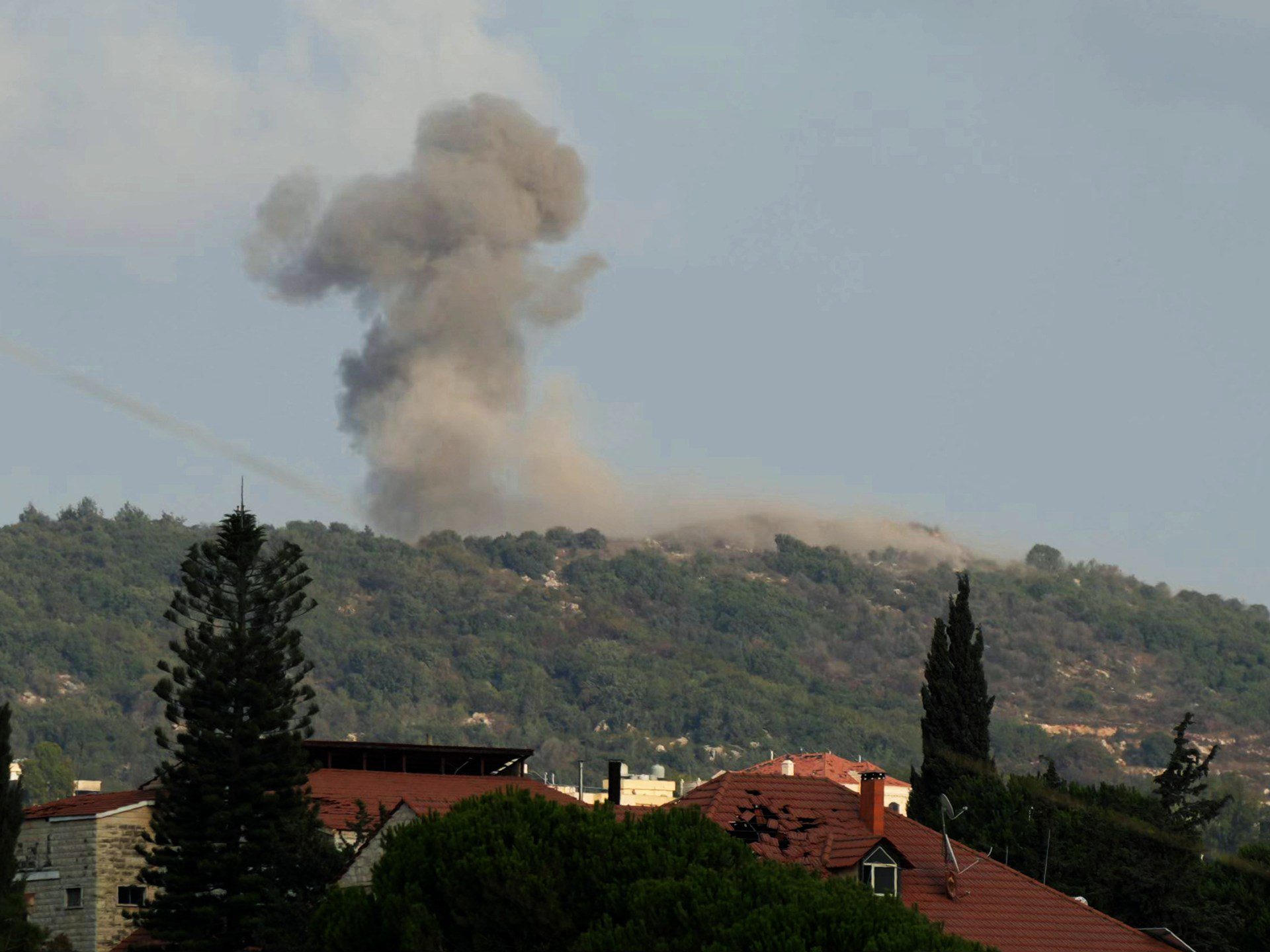
Israeli air strikes have killed at least 11 people and wounded 19 in southern Lebanon, according to the Lebanese Ministry of Health, amid intensified attacks across several towns and villages overnight.
Early morning attacks on Saturday struck Ansar and Deir ez-Zahrani in Nabatieh district. In Ansar, seven were killed, including three children, and two were wounded. The attack in Deir ez-Zahrani killed four and wounded 17.
Recommended Stories
list of 4 itemsend of list
Hezbollah issued a statement urging the Lebanese government to abandon what it calls “humiliating” direct negotiations and to stop relying on US mediation, saying that Washington backs Israel’s interests over Lebanon’s sovereignty.
The group also warned that the Israeli attacks would be met with an “appropriate response”.
“The Israeli enemy must understand well that its assaults, its transgressions, and its attempts to impose a fait accompli cannot continue, and will be met with what they deserve,” the statement said.
Lebanon’s parliament speaker Nabih Berri, meanwhile, called the Israeli attacks a “massacre” and said they represented the continuation of a “war aimed at extermination” in southern Lebanon.
Al Jazeera’s Ali Hashem, reporting from Ansar, said children and members of one family were among those killed.
“This is an area seen by people as safe, but an air attack has now hit,” Hashem said, adding that the attack had increased fear among residents as Israeli strikes and demolitions continued across southern Lebanon.
The Israeli military said it had struck what it described as Hezbollah infrastructure in the areas of Nabatieh and Ansar, saying the attacks came in response to an action against Israeli soldiers at the Ali al-Taher Ridge.
Lebanese Prime Minister Nawaf Salam rejected Israel’s account, calling the escalation “extremely dangerous” and saying it was undermining efforts to consolidate stability in southern Lebanon.
He said responsibility for dealing with any military infrastructure on Lebanese territory, “if it exists”, rests exclusively with the Lebanese state, through the army and other state institutions.
“Its presence does not give Israel the right to violate Lebanese territory or put civilians at risk,” Salam said, calling on Israel to halt the escalation.
Lebanese President Joseph Aoun also condemned the continuing Israeli attacks on southern Lebanon, particularly in Nabatieh and surrounding areas, saying they constituted repeated violations of the framework agreement, the work of the military coordination group and international laws protecting civilians.
Aoun said the attacks sent “a clear message” about the negotiating process and US efforts to implement the agreement.
Strikes across southern Lebanon
The National News Agency (NNA) said Israeli attacks intensified early on Saturday, with a series of air strikes on the Ali al-Taher Ridge near Nabatieh al-Fawqa.
Two other strikes hit areas near the teachers’ training centre and the Husseini club in Nabatieh al-Fawqa, while the valley between Ansar and Zarariyeh was also attacked in what NNA described as the first strike to reach this far into southern Lebanon since the ceasefire two months ago.
Closer to the border, Israeli forces destroyed several homes in Bint Jbeil and opened heavy machinegun fire towards houses along the Kounine-Saf al-Hawa road, the agency reported.
An Israeli air attack also hit the al-Mashaa neighbourhood in al-Mansouri shortly before midnight.
Al Jazeera’s Hashem said Israeli demolitions had also continued in border areas, with some villages suffering extensive destruction, including damage to graveyards and historic sites.
“This is escalating day by day,” he said, adding that diplomatic efforts had yet to produce results on the ground.
Violence has decreased since a United States-Iran memorandum of understanding in June and a subsequent US-sponsored framework agreement between Lebanon and Israel, but Israeli attacks and demolitions have continued in the south.
The framework calls for Hezbollah’s disarmament, the gradual withdrawal of Israeli forces and the deployment of the Lebanese army in southern Lebanon.
On Friday, Hezbollah leader Naim Qassem criticised the Lebanese authorities over the implementation of the framework, accusing them of pressuring the army while Israeli attacks continued.
“How can you accept this ongoing humiliation of the Lebanese army, exposing it to bombardment and Israeli pressures, instead of acting as its protectors?” he said.
On Thursday, Israeli Defence Minister Israel Katz said Israel would not withdraw unless Hezbollah was disarmed and what he called the “threat” posed by the group was removed.
Katz said Israeli forces currently control about 700 square kilometres (270sq miles) of Lebanese territory, or roughly 7 percent of the country.
The Ansar attack was the deadliest reported Israeli strike in Lebanon since agreements reached in June led to a significant reduction in hostilities between Israel and Hezbollah.

