


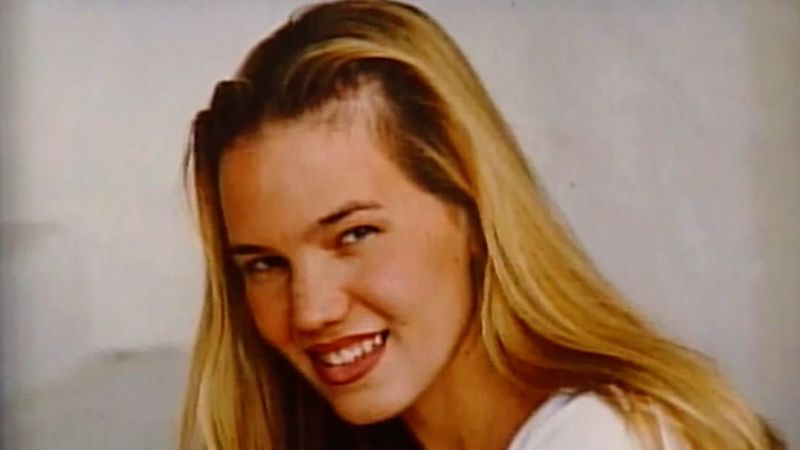
The investigation into the 1996 disappearance of Kristin Smart has been characterized by decades of critical questions, starting with the whereabouts of her remains.
Now, new questions are emerging as authorities have concluded their most recent search at the home of the mother of Paul Flores – the man convicted of Smart’s murder – and say they have not recovered Smart’s remains after new soil testing had returned signs of human remains. Will other locations be searched or searched again with new techniques? Will evidence they say they are still evaluating lead them in new directions?
The quest for answers in the case has captivated the public’s attention ever since the college freshman vanished from California Polytechnic State University’s San Luis Obispo campus over Memorial Day weekend in 1996. A decadeslong investigation led to the trial and conviction in 2022 of Paul Flores for her murder.
Still, key questions have stood in the way of the Smart family’s pursuit of some semblance of closure and their hope to “finally lay her to rest in the presence of those who love her.”

The new search at the home of Susan Flores underscored a renewed commitment to finding answers in the Smart case.
“Until we have Kristin, everything is still wide-open,” San Luis Obispo County Sheriff Ian Parkinson told reporters Friday.
Susan Flores’ Arroyo Grande home has been searched multiple times during the 30-year investigation. But Parkinson said there have since been advances in the soil science and the ground-penetrating radar investigators used to scour the property.
CNN reached out to attorneys who previously represented the Flores family and to Susan Flores but did not hear back.
Last week, investigators descended on Flores’ mother’s home, combing through the packed garage and examining the deck.
“Kristin has been moved, and we don’t know how many times she’s been moved and to where she’s moved, and so just because somebody’s house was searched doesn’t mean that we’re not going back there, because she could have been moved back there thinking that it’s a safe place,” the sheriff told reporters before later announcing Saturday the search had concluded without recovering Smart.
Authorities had a search warrant permitting them to return to the home based on “investigative leads and evidence,” the sheriff previously said, as well as “information that was derived from what we have to deem as a witness.”
Parkinson would not disclose what new information enabled investigators to get the latest warrant.
A Sheriff’s Office spokesperson told CNN the warrant permitting authorities to enter and search the property remains sealed, meaning the underlying evidence presented to the judge is not yet public.

Smart’s remains were not recovered in the latest search in Arroyo Grande, the sheriff’s office said Saturday while announcing the search had been concluded.
The agency did not elaborate on the search at the home, only saying any evidence recovered would be sent for evaluation to “aid in the investigation.”
“The Sheriff’s Office remains fully committed to finding Kristin and bringing her home to her family,” the sheriff’s office said Saturday.
The sheriff had previously said evidence indicated human remains “were there at one time or still there,” but could not say whether they were Smart’s.
The home’s yard was described by the sheriff as “a very small area back there to search, but also, as you can see, it’s quite crowded with stuff,” which complicated their efforts.
What led to signs of human remains at the home?
Advances in soil science were key to the latest search after new soil testing returned some indications of human remains, Parkinson said.
Investigators also used ground-penetrating radar – technology that uses sound waves to map structures below the ground – to scour the property, according to Parkinson.
Soil samples are collected and analyzed for human DNA at a local lab, Parkinson said.
“We’re also conducting soil tests and that’s kind of the scientific part. I’m not going to go into the details other than to just say … it’s about the compounds in the soil that are related to a human decomposing body,” the sheriff said previously.

Tim Nelligan, an expert in soil vapor testing, told The Associated Press last week he was on the premises, gathering samples in Susan Flores’ yard as well as a neighbor’s yard.
Nelligan declined to discuss the investigation but said his “team has, in general, ‘come up with a methodology to assess soil vapor’ and its relation to ‘human cadaver decomposition.’”
Parkinson had described the search as a methodical, step-by-step process.
“They’ve been analyzing every night since we’ve been there,” he added. “Then that data goes to the person that’s going to interpret it … and see if that data matches the thresholds. So, it’s a long process.”
“We are not leaving that house until we are sure that we have checked everything,” Parkinson said before the search concluded Saturday without recovering Smart.
Smart’s family has said they feel as if Paul Flores continues “to stand in the way of our daughter being returned to us.”
In an interview with CNN three years after their daughter went missing, Stan and Denise Smart said they hoped to one day be able to lay their daughter to rest.
Their message for Paul Flores: “We will have a resolution and he will wish that he’d come forward much sooner,” Denise Smart said.
“We believe he’s definitely involved,” her husband added. “The best outcome would be that we’d be able to find our daughter’s remains and we’d be able to have some justice.”
In a statement posted on their website, Smart’s family said: “For thirty years, we have lived with a pain no family should have to endure, as heartache, frustration, and setbacks have woven themselves into our everyday lives.”

For decades, Flores remained a person of interest in Smart’s disappearance. Smart was last seen with Flores, then a 19-year-old freshman who walked home from a party with her.
Flores was 43 years old when the sheriff’s office obtained a warrant to monitor his cellphone and messages. In February 2020, detectives served a search warrant at his home, as well as the homes of his sister, mother and father, according to the sheriff’s office.
They also recovered physical evidence from Flores’ home in April that year, the office said.
Then a year later, in March 2021, detectives served a warrant at the Arroyo Grande home of Flores’ father, Ruben. Detectives used ground-penetrating radar and dug the property using hand tools, the sheriff’s office told CNN at the time.
“Additional evidence related to the murder of Kristin Smart is discovered at the site,” the sheriff’s office said in a statement.
Prosecutors would later allege Ruben helped his son hide Smart’s body under the family’s deck before relocating her remains.
On April 13, 2021 – almost exactly 25 years since Kristin Smart disappeared – authorities arrested Paul Flores and charged him with her murder.
Ruben Flores was also arrested and charged with allegedly aiding Flores in hiding Smart’s body.
Prosecutors argued Paul Flores raped or attempted to rape Smart and killed her in his dorm room before enlisting his father to allegedly help him hide her body under the deck of his home.
Attorneys representing the Flores family vehemently asserted their clients’ innocence, repeatedly citing a lack of eyewitnesses and evidence.
Paul Flores was found guilty of first-degree murder in October 2022 and later sentenced to 25 years to life in prison.
His father, Ruben, was acquitted of the charges against him. Outside the courtroom, Ruben Flores told reporters, “It’s too bad the system works that way, on feelings instead of facts.”
He said he felt bad for Smart’s family because they never got a true answer about what happened to their daughter.
Parkinson said Susan Flores has long been a person of interest in the case. She has never faced charges related to the Smart case. “We have no lawful reason to detain her at this point,” he said.

