


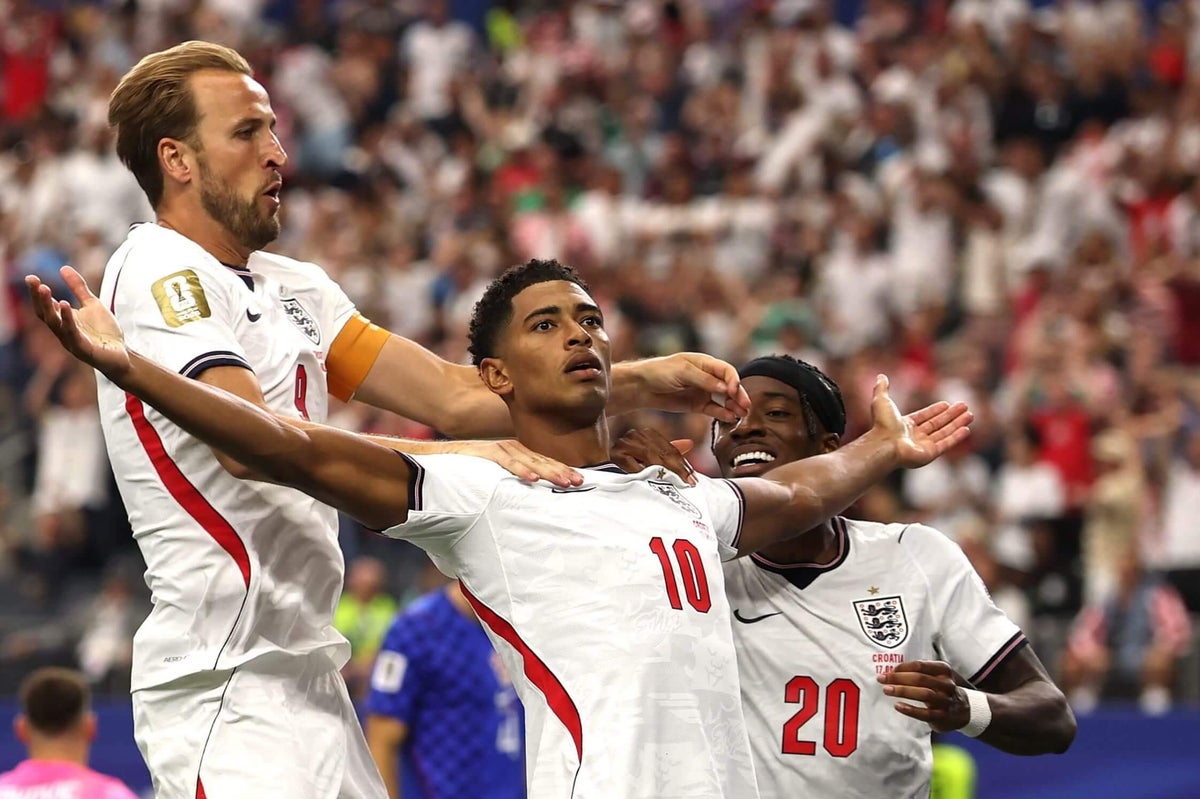
England are almost guaranteed to reach the World Cup knockout rounds after a thrilling and at times chaotic win over Croatia in Dallas sent them top of Group L.
The first half of England’s campaign brought four goals, with Harry Kane scoring a retaken penalty and heading in from an out-swinging corner, only for Croatia to equalise each time. First, Martin Baturina fired past Jordan Pickford from the edge of the box, then Petar Musa, a striker for local MLS side FC Dallas, finished a brilliant team move to bring it level at the break.
The game continued at a frantic pace in the second half, and it was England who went ahead when Jude Bellingham ran down the right, carrying the ball and finding the bottom corner. Marcus Rashford came off the bench to score a fourth, while Kane appeared to be OK after grabbing his left calf towards the end.

This win leaves England with a greater than 99 per cent chance of reaching the round of 32, according to The Athletic’s projection model.
In this first 48-team World Cup, the top two from each of the 12 groups go through, along with the eight best third-placed sides. If they win the group, England will play a third-place team from one of Groups E, H, I, J or K in their first knockout game in Atlanta on July 1.
The Athletic’s Oliver Kay, Liam Tharme, Tim Spiers, James Horncastle and our refereeing expert Graham Scott break down the key moments.

Do England look like contenders?
The first week of this World Cup has brought a variety of performances from the leading contenders. There were convincing wins for Argentina, Germany and, ultimately, France, but disappointing draws for Brazil (against Morocco) and particularly Spain (against Cape Verde) and Portugal (against DR Congo).
In that context, England fans will be delighted that their team are off to a winning start, and showed signs of real attacking quality at times. Even if Croatia are not the force they were when beating England in the 2018 World Cup semi-finals this was, on paper, the toughest game of the group for head coach Thomas Tuchel’s team. The upcoming matches against Ghana and Panama offer the opportunity to settle into the tournament, and without the pressure that can easily build when a team start poorly.
This felt a little like when England beat Iran 6-2 in their opening game of the previous World Cup in Qatar four years ago: some really encouraging some aspects, some areas for improvement, notably in defence. But Tuchel will not allow his players to relax or to feel complacent. That much was spelt out by his assistant Anthony Barry, who, in a half-time interview with UK broadcaster ITV, said England’s players had shown “nervous energy” early on and fallen into “fearful patterns” during a “complicated and confusing first half”.
Barry was right. It wasn’t perfect. But it was a highly encouraging start, particularly looking at the way some of the other leading contenders have been slow off the mark. England have hit the ground running.
Oliver Kay
What difference did Bellingham make for England?
Just minutes after assistant Barry had been scathing of England’s first-half performance in that TV interview, Bellingham stepped up to retake the lead and show what the coaches had wanted in the opening 45 minutes. Bellingham’s smart angled finish, his seventh goal for his country, capped a tidy, direct attack after Elliot Anderson’s booming ball over the top had sent the Real Madrid midfielder through.

Having big-moments players matters more than anything else at major tournaments, particularly with Kylian Mbappe, Erling Haaland and Lionel Messi all delivering for France, Norway and Argentina in the previous 24 hours. Bellingham put in a real shift off the ball too, with England fans cheering a tackle he made out on the touchline on 68 minutes, just before the second half’s hydration break.
He moved into a deeper role late in the game when Morgan Rogers came on, that positional versatility a real strength before Djed Spence replaced him on 79 minutes.
So is that him cemented as England’s No 10? Perhaps not, there’s strength in depth with Rogers competing for that spot and he offers a better back-to-goal option for receiving passes, should Tuchel want a different profile. Bellingham is outstanding at breaking into space, as he showed for the goal, and he duels really well, too.
Because England prioritise balance, it’s unlikely Rogers and Bellingham will be played together from the off in games.
Liam Tharme
Why did England get a second chance at the penalty?
The early decision to award England a penalty was as easy as they come, with Luka Modric committing a careless foul on Noni Madueke, but as France had discovered on Tuesday night, that does not always mean that the officials reach the correct outcome. So chapeau to Clement Turpin for getting the first bit right.

Modric fouls Madueke to concede the penalty (Reuters)
As for the decision to order a retake after Kane’s effort was saved, well, it’s two simple rules.
If the kick is saved and a defender then gets involved, the kick is retaken. If an attacker enters the box too soon and affects the play, he immediately concedes a free kick. Any player who encroaches at a penalty is plain daft.
Being on the line at the moment the ball is kicked counts as being inside, which many players do not know, although the replays clearly showed Josko Gvardiol well inside the area when Kane struck his first attempt.

Livakovic saves Kane’s first penalty, but was off his line too soon (Reuters)
Second, if the goalkeeper leaves his line before the shot is taken — as Dominik Livakovic did here — then, again, the kick must be retaken if it is saved.
This was the correct call — and it proved costly to Croatia.
Graham Scott
How has Kane changed his penalty technique?
Kane sent his two penalties (one saved, one scored) to the same side of the net against Croatia. However, there was a noticeable difference in the way he approached the two, with separate run-ups.
Kane’s first, spurned effort was after a stuttered run-up, a technique he has introduced sporadically in recent years since moving to Bayern Munich from Tottenham Hotspur in 2023 with the intention of having another bow in his penalty armoury, given how many of them he takes (Kane has scored, according to Transfermarkt, 108 penalties in his career and missed 14).

For his second, scored, penalty (below) it was back to the classic Kane ploy of quick approach and fire the ball into the corner.
Interestingly, when scoring two penalties for Bayern against Hoffenheim last September, Kane went with the stuttering method for his first effort and then his more orthodox run-and-shot for the second, albeit both went in. Today, as then, he directed both penalties towards the same corner but with different run-ups.

“The second one’s always easy,” he said after that 4-1 win for Bayern. “I have both the techniques to try and keep the keepers guessing.”
Geir Jordet, The Athletic’s penalty expert for the 2026 World Cup, said: “Kane’s last two penalties before the World Cup were goalkeeper-independent (where the taker decides beforehand where to shoot) and he scored both.
“I thought he would save what seems to be his favoured technique — goalkeeper-dependent (where the taker waits for the ’keeper to move) — for the World Cup, and he did with his first penalty attempt.
“The problem for Kane was that he was facing a goalkeeper in Livakovic who is very good at stopping penalties and very clever with his movement. He shifts a little to his right. It is very well-timed and persuades Kane that the other side will be open, but then Livakovic switches his centre of gravity and moves in the opposite direction. This makes it difficult for Kane, and his shot was saved.”
Tim Spiers
Who is Martin Baturina?
Martin Baturina. Remember the name? Como knew it already last summer when they agreed to pay Dinamo Zagreb €18million for the silky attacker. Baturina struggled to make an immediate impact but competition for places was at a premium. Nico Paz and Jesus Rodriguez, in particular, have been outstanding at Como, as has Assane Diao when fit. It is a credit to the 23-year-old that he forced his way into the team.
“He is very intelligent,” Como head coach Cesc Fabregas said. “Everyone talks about his first touch and use of the ball. But the thing that surprised me was how he defends.”
Baturina’s youthful exuberance was, in many respects, symbolic of Como’s run to a historic qualification for next year’s Champions League. He scored six times in his first season in Serie A, and also got goals against Inter and Napoli in the Coppa Italia. It is no surprise to see him deliver on the World Cup stage, curling in Croatia’s first today.
James Horncastle
Was England’s corner goal from football’s past?
There was a whole lot of World Cup 2018 about Kane’s, and England’s, second goal today.
The well-placed header by the striker from Declan Rice’s corner looked like a routine straight off the training ground. Kane was the deepest runner, with other aerial threats in Nico O’Reilly and John Stones ahead of him. They ended up playing decoy and blocker roles, occupying the Croatia players and preventing them getting out to Kane, who jumped off both feet to power the header into the bottom-left corner and well out of Livakovic’s reach.
England had used the same outswinging routine to score against New Zealand in a pre-World Cup warm-up match and it’s the tactic which worked so well in 2018 when they made the semi-finals under Gareth Southgate.

Back then, it was Kieran Trippier outswingers for Harry Maguire that were England’s main threat, and a reason to dust off this blueprint is the strictness of officiating around blocking at the tournament — referees are permitted to give fouls for contact which takes place before the corner is taken, a rule introduced in part because of the sheer volume of grabbing and duels at inswinging corners in the Premier League last season.
And it made extra sense against Croatia, who play with a back three and have height in abundance across their team, so anything curling towards goal is likely to favour them, even if it meant a change in delivery type for Arsenal midfielder Rice, who has perfected those whipped balls on top of the goalkeeper over the past two seasons.
Liam Tharme
Was this the goal of the tournament so far?
Croatia played headers and volleys on football’s biggest stage for what may, just may, be the goal of this World Cup so far.
It started with Mario Pasalic, 40 yards from goal, looking up, spotting Ivan Perisic’s dart into the box and chipping a gorgeous clipped pass, with Perisic having the wherewithal to spin with his back to goal and place a perfect header to his right in the direction of Musar.


The FC Dallas player, in what has been his adopted hometown since a 2024 move from Benfica, met it first time with a guided, side-footed volley beyond Pickford. Perfection.
Every touch and every movement had to be precise and perfect. And it was. What a goal.
Former Manchester United midfielder Roy Keane said on ITV’s coverage of the game: “You mightn’t see a better goal than this in the tournament. The movement, quality, the finish, the composure… It’s brilliant movement, but you’ve still got to get the right ball and the weight of it… You look at England’s back four going, ‘We’re in a great position’, but that bit of quality? Fantastic.”
Tim Spiers
Did the gamble on John Stones work?
Marc Guehi was one of England’s standout performers at the European Championship finals two years ago, starting six of their seven games and only missing the other through suspension. Even after Tuchel took over in early 2025, central defence appeared to be a question of Guehi plus one.
But as their opening World Cup game loomed, it emerged that Tuchel was leaning towards a partnership of Ezri Konsa and Stones.
Did it work? Well, England won the game, but the defence — not just Konsa and Stones — did not convince. The ease with which Croatia carved them open for those two first-half equalisers was a concern. As former Manchester United and Denmark goalkeeper Peter Schmeichel said on Fox’s U.S. TV coverage at half-time, “They (England) have been weak at the back.”
The sight of Stones desperately sliding in on Petar Sucic, only for the Croatia forward to skip inside and set up Baturina to make it 1-1, was unexpected because he is one of those defenders who does not usually find himself at full stretch. It would be easy to put it down to rustiness, given his lack of football in what has been his final season at Manchester City, but it was all part of a collective breakdown that was repeated for Croatia’s second.
Likewise, there will be a temptation to point fingers at Konsa for the second goal, but full-back Reece James didn’t cover himself in glory either.
England tightened up considerably after the break and should have more than enough to get through the group stage, but there are issues for Tuchel to try to iron out as the tournament progresses.
Oliver Kay

