


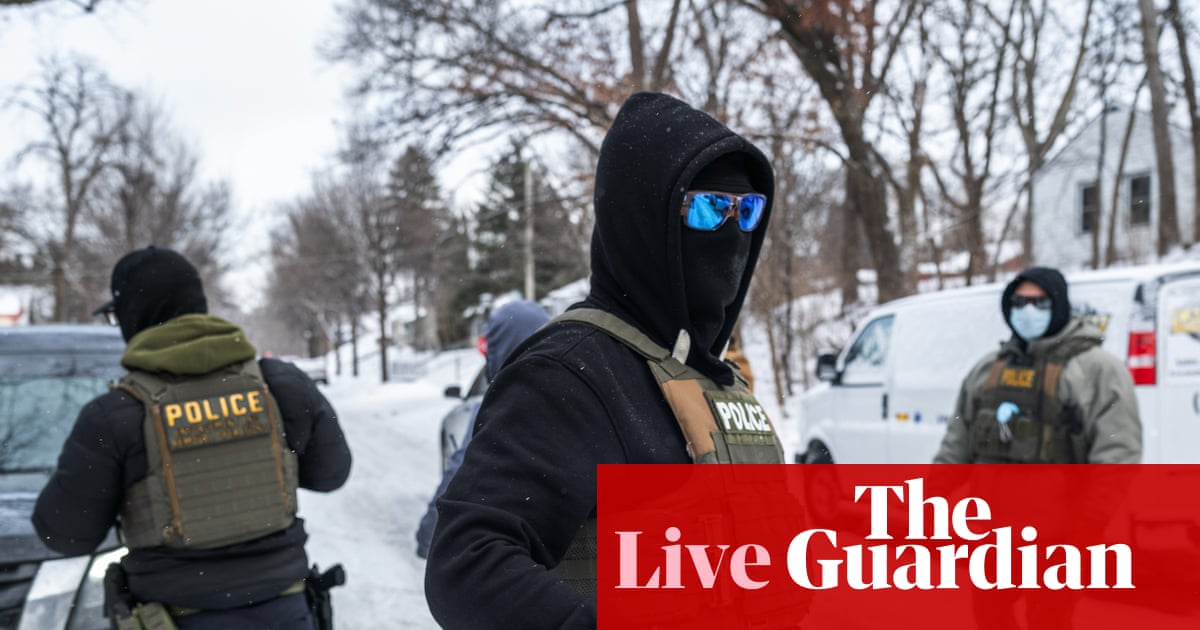
Federal judge blocks effort to subpoena Minnesota governor Tim Walz and officials
A federal judge has blocked efforts to subpoena Tim Walz and other Minnesota officials, calling it an attempt to “harass and retaliate against them”, the AP reports.
US district judge Patrick Schlitz ruled that the main purpose of the subpoenas – part of a Trump administration investigation into alleged obstruction of deadly ICE raids in the state earlier this year – was to “coerce Minnesota officials into assisting the federal government with enforcing civil immigration law and to harass and retaliate against them for failing to do so.”
Minnesota governor Walz said the ruling was “a victory for the rule of law and our democracy”.
Key events
As he described the two executive orders he was about to sign in the Oval Office on Monday, Donald Trump seemed to reveal that he had no idea what at least one was about.
Reading from a binder on his desk, Trump said: “The second order I’m signing directs federal agencies to transition to what is called quantum … cryptography.”
The president paused before mispronouncing the word cryptography as “crypto-graphy”. He then looked up at reporters assembled in the room and asked: “Does anybody know what that is?”
Trump signs executive orders on quantum technology, gripes about not winning Nobel prize
At the start of an Oval Office event to sign two executive orders on quantum technology, Donald Trump just welcomed some of the officials and experts standing behind his desk.
When Trump introduced “Nobel prize-winning quantum physicist John Martinis”, he looked to his right at the silver-haired physicist and said: “Great going. Should you tell them how many years ago it was?”
Martinis, who won the Nobel in 2025, joked that it was “about 40 years ago”.
Trump, apparently not in on the joke, told the physicist who is in his late 60s, “and you still look good”.
The subject of the Nobel having been raised, the president, who recently started two armed conflicts, took the opportunity to return to his grievance about not having been awarded a Nobel peace prize. “I’ve been waiting for one of them too. They don’t think eight wars in enough,” referring to his invented claim to have settled that many armed conflicts. “Even though nobody’s even done one,” he griped, inaccurately.
Despite an adverse court ruling, the US Department of Justice is refusing to back off its claim that Minnesota’s governor, Tim Walz, attorney general, Keith Ellison, and the Minneapolis mayor, Jacob Frey, should all be investigated for breaking the law by refusing to cooperate with federal immigration raids in the state that led to the killing of two peaceful protesters, Renee Good and Alex Pretti, by federal officers.
Earlier on Monday, the US district court for Minnesota unsealed an order from Chief Judge Patrick Schiltz rejecting subpoenas for the elected Democrats as politically motivated.
Schiltz, a former Republican Senate staffer who clerked for supreme court justice Antonin Scalia before being nominated to the federal bench by George W Bush, wrote that initiating an investigation “in order to ‘harass political opponents or to coerce them into taking official action – particularly official action that the federal government cannot directly require those political opponents to take – is a blatantly unlawful and unethical use the grand-jury process”.
Despite this stinging rebuke from a conservative jurist, a spokesperson for the Department of Justice insisted in a statement to the Guardian that it was simply investigating unlawful behavior.
“The Department takes the unlawful obstruction of federal law enforcement operations extremely seriously and will continue to act in full compliance with the law to investigate these matters”, the spokesperson said.
Rachel Leingang
Here’s a more in-depth report on a federal judge blocking the justice department’s attempt to subpoena Minnesota’s governor, Tim Walz, attorney general, Keith Ellison, and the Minneapolis mayor, Jacob Frey, from our Minneapolis-based Midwest political correspondent, Rachel Leingang.
A federal judge agreed to quash the US federal government’s subpoenas of leaders in Minnesota issued during the Trump administration’s controversial immigration crackdown on the state earlier this year.
The US Department of Justice issued subpoenas to the Minnesota governor, Tim Walz, the attorney general, Keith Ellison, the Minneapolis mayor, Jacob Frey, and other local officials in the Twin Cities in January.
The department said it was investigating the officials for obstructing federal immigration enforcement. Local and state officials largely did not support the federal enforcement surge, during which federal agents killed two US citizens, Renee Good and Alex Pretti, in the streets.
The US district court for Minnesota unsealed an order from Chief Judge Patrick J Schiltz on Monday that showed the subpoenas were rejected as politically motivated. Ellison posted the unsealed order on Monday, saying the decision to quash the subpoenas was an “extremely rare step” by the court.
In the order, Schiltz wrote that the Trump administration had been “threatening and attempting to punish states and localities that have adopted ‘sanctuary’ policies”. He noted that initiating an investigation “in order to ‘harass political opponents or to coerce them into taking official action – particularly official action that the federal government cannot directly require those political opponents to take – is a blatantly unlawful and unethical use the grand-jury process”.
Read Rachel’s full report here:
Trump’s effort to subvert mail-in voting suffers another setback in Maryland
A federal judge ruled on Monday that Maryland election officials do not have to comply with a demand from the Trump administration to turn over the state’s complete list of registered voters, dealing another legal setback to Donald Trump’s plan to subvert mail-in voting by asserting federal control.
In her opinion, US district judge Stephanie Agli Gallagher, who was nominated to the court by Trump in 2019, rejected the Department of Justice’s claim that the Civil Rights Act of 1960 required states to turn over complete voter rolls as “absurd”.
The Democratic election and voting rights attorney Marc Elias celebrated the decision in his Democracy Docket newsletter, writing:
Donald Trump desperately wants to build a national database of voters. His plan is to have his administration control who stays on the list and who gets removed. He has issued unconstitutional executive orders to accomplish this goal, and the U.S. Postal Service has proposed a new rule to do his bidding.
The problem for Trump is that his Department of Justice keeps losing cases that it needs to access this critical data. This humiliating string of defeats threatens to derail Trump’s signature plan to subvert the 2026 midterm elections.
This morning, a federal judge in Maryland handed the DOJ its ninth defeat in a series of 31 cases the department has filed to gain access to state voter files. The DOJ has yet to win a single one. The court wrote that it “joins every court to have addressed this issue in concluding that [a state voter file] is not a record or paper that a state must produce to the United States.”
Importantly, of the nine cases the DOJ has lost, five were decided by judges nominated by Trump.
As the Guardian reported in May, the US Postal Service could throw the upcoming midterm elections into chaos by requiring states to provide lists of voters who received mail ballots, according to a draft rule.
Nearly one in three Americans voted by mail in 2024, but Trump, who wants to restrict the number of voters by limiting ballots cast by mail, signed an executive order in March that prohibits the USPS from delivering ballots to any voters not on a federal list of citizens deemed eligible to vote in each state by the Department of Homeland Security.
The USPS proposal to implement this order seeks to require states to give the postal service the names and barcodes tied to mail-in ballots for federal elections. The public will have until 2 July to comment on the proposed rule before the Trump administration can finalize it.
Vance says he did not feel snubbed by Iran’s foreign minister during viral moment before talks
Before boarding his flight home from Switzerland, the US vice-president JD Vance spoke to reporters on the tarmac and was asked if he felt snubbed by Iran’s foreign minister, Abbas Araghchi, when Iran’s top negotiator came into the same room as him but did not greet the American.
“No,” Vance said. “I’ve spent a lot of time dealing with the Iranians over the last few months. Sometimes I find them extremely confusing as negotiators.
“What I did find kind of funny is that after that initial meeting, there was this, you know, sort of social media firestorm where everybody said the Iranians are going to leave, and then we proceeded to talk to them for like the next nine hours,” Vance added. “So I would just encourage the media, mistrust a little bit what you see coming out of Iranian social media. They could be confusing negotiators, but we feel like we’re making progress.”
Video of Iran’s foreign minister leaving the room without acknowledging Vance was indeed viewed millions of times on social media.
The vice-president also said: “We continue to make progress on these technical negotiations. We left a lot of our team, the Iranians left a lot of their team at the resort there to keep on working at it.”
Minneapolis mayor Jacob Frey said the investigation was “never about justice, law, and order, but the absence of it”.
“Subpoenaing political opponents because they spoke on behalf of their constituents violates the core tenets of our democracy and human decency,” he said, according to AP reports.
Frey also observed that criticizing government action is not a crime. “One of the defining strengths of our democracy is the ability to challenge those in power without fear of retribution. Elected officials have both the right and the responsibility to speak honestly about how government decisions affect the people they serve,” he said.
Keith Ellison, the Minnesota attorney general, said “it should disturb every American that Donald Trump is weaponizing the criminal justice system against people he disagrees with”.
Kaohly Her, St Paul mayor, said the subpoenas were “a politically motivated retaliation against our city for lawfully standing up to ICE and fighting for our residents”.
Walz says case is example of DoJ going after Trump’s political opponents
The subpoenas were first issued in January amid a violent immigration crackdown in Minnesota that led to the killings of Minneapolis residents Alex Pretti and Renee Nicole Good.
As well as Tim Walz, the Trump administration issued subpoenas for Minneapolis mayor Jacob Frey, the offices of the state attorney general, Keith Ellison, the Hennepin county attorney, Mary Moriarty, the St Paul mayor, Kaohly Her, and the Ramsey county attorney, John Choi.
On Monday, Walz – who was Kamala Harris’s running mate in the 2024 election – issued a statement after the ruling, saying: “The US justice department is pursuing criminal investigations into the president’s political opponents. This case was just one example of that, but we are seeing daily reminders of this administration’s lawlessness — in Minnesota and around the country. We all must continue to seek justice and uphold the rule of law.”
Here’s more from the AP on the federal judge’s ruling:
The ruling is the latest rebuke by the federal judiciary of Justice Department efforts to aggressively implement the Trump administration agenda in courts and target the president’s political adversaries through subpoenas and similar demands.
The judge ruled that there appeared to be “extremely weak to nonexistent” connections between the information sought in the subpoenas and any possible criminal violation. The subpoenas seek materials “that largely if not entirely relate to constitutionally protected conduct,” the judge wrote, noting that Minnesota has the legal right not to devote its resources to enforcing federal immigration law.
The Justice Department “is not conducting a criminal investigation,” the judge wrote, “but is instead using the grand jury process for other (unlawful) purposes.”
The evidence that the subpoenas were issued for unlawful reasons is overwhelming, the judge said, arguing that the Justice Department “has struggled — without success — to identify a single plausible investigatory justification” for them.
The DoJ has yet to comment on the ruling.
Federal judge blocks effort to subpoena Minnesota governor Tim Walz and officials
A federal judge has blocked efforts to subpoena Tim Walz and other Minnesota officials, calling it an attempt to “harass and retaliate against them”, the AP reports.
US district judge Patrick Schlitz ruled that the main purpose of the subpoenas – part of a Trump administration investigation into alleged obstruction of deadly ICE raids in the state earlier this year – was to “coerce Minnesota officials into assisting the federal government with enforcing civil immigration law and to harass and retaliate against them for failing to do so.”
Minnesota governor Walz said the ruling was “a victory for the rule of law and our democracy”.
Donald Trump said Iran will agree to have weapons inspections in future to ensure what he called “nuclear honesty”.
The president’s Truth Social post on Monday echoed comments made by his vice-president, JD Vance, who said Tehran had agreed to allow nuclear inspectors back into the country “as soon as today”.
Trump said: “Everybody is fully aware that Iran will agree to have Major Weapons Inspections in order to ensure “Nuclear Honesty” long into the future.”

