
The Federal Reserve held interest rates steady in the range of 3.5%-3.75% on Wednesday in a unanimous decision that comes at a pivotal time for the Fed and central banks around the world.
Nine of 18 members of the Federal Open Markets Committee projected that they see a rate hike coming this year, in what is being read as a hawkish tilt for the Federal Reserve. The projections pushed traders to fully price in one quarter-point rate hike by the end of the year, and stocks pulled back on the news.
“Economic activity is expanding at a solid pace despite elevated uncertainty that owes, in part, to the conflict in the Middle East,” per the Federal Reserve’s statement on the decision. “Productivity growth and capital investment are strong. Job gains have kept pace with the workforce, and the unemployment rate has changed little.”
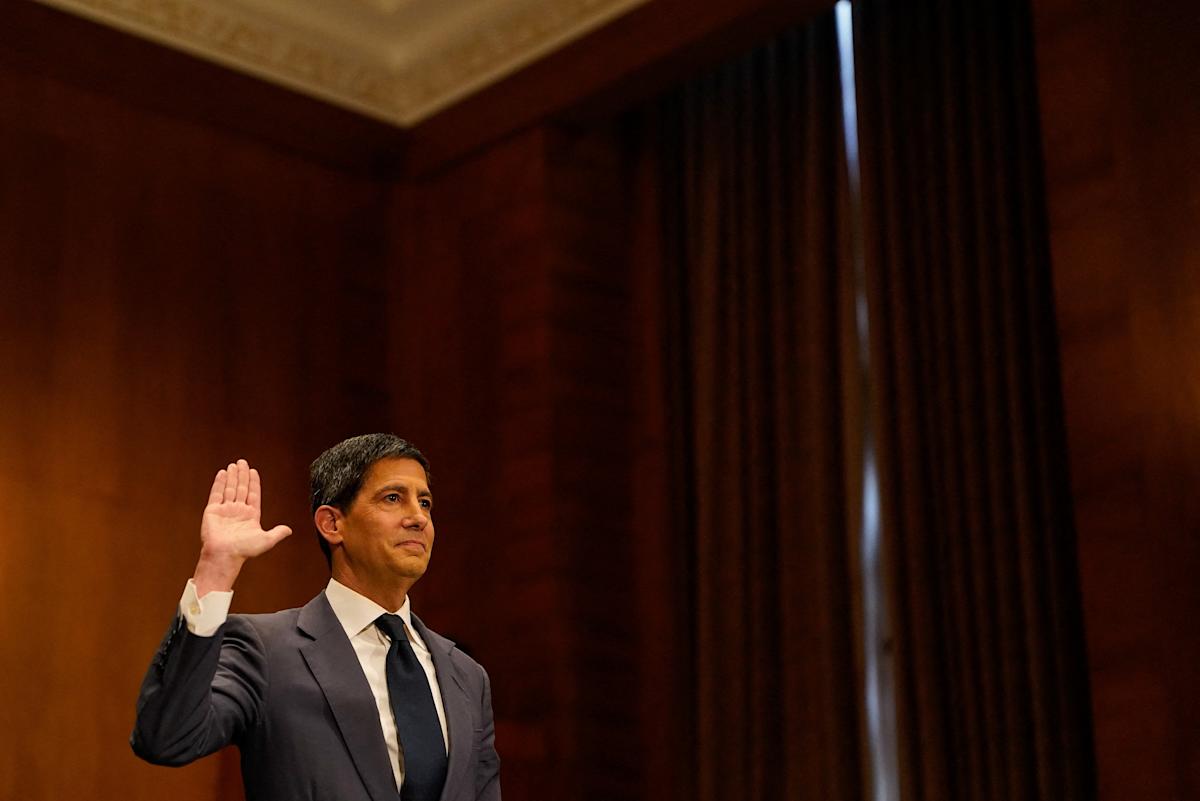
The June meeting, which kicked off Tuesday, was Kevin Warsh’s first as the central bank’s chairman. In comments leading up to the meeting, Warsh had suggested he will adopt a different governing approach from former Fed Chair Jerome Powell and aims to emulate former Fed Chair Alan Greenspan.
In Wednesday’s meeting, the new chairman laid out some of those changes, noting that the Federal Reserve had “dropped forward guidance,” and that while he encouraged his fellow FOMC members to submit so-called “dot-plot” projections, he chose not to participate. Warsh also said he would be establishing several task forces to review areas including Fed communications, its balance sheet, and the central bank’s inflation frameworks.
Key to Warsh’s commentary was a statement that he believes financial markets “perform best when they react to incoming data,” and “work less efficiently when they ask a question, ‘How will the Federal Reserve react to that incoming information?'”
Notably, Warsh has not committed to holding press conferences after every policy meeting, a practice Powell instituted. Warsh suggested in Wednesday’s press conference that the practice would be reviewed.
LIVE 25 updates
Warsh is cagey on his meetings with the Trump and his team: ‘I don’t have anything for you’
Kevin Warsh took a question on Wednesday at his first press conference about whether President Trump and his team are in touch and looking to change the Treasury department’s relationship with the central bank or perhaps pressure him to lower rates.
The new chairman of the Federal Reserve made clear he’d prefer not to give an answer.
“So on the president, I don’t have anything for you,” he said on the question of President Trump’s contacts with him since he was sworn in a few weeks ago. Warsh then jokingly noted that Treasury Secretary Scott Bessent has been posting pictures of their breakfasts, “so I don’t think I can deny that.”
Warsh added that his three breakfasts with Bessent so far have been “very useful discussions” with Warsh reiterating his view that the conduct of monetary policy can remain independent, “but that doesn’t mean we’re not interested in what’s happening with the fiscal authorities.”
“I won’t be breaking any news here to suggest I’m quite interested in what’s happening in the Middle East,” he added. “It does have some effect on our day job.”
Warsh says markets ‘perform best when they react to incoming data,’ rather than asking what the Fed will do
Kevin Warsh said financial markets “perform best when they react to incoming data” instead of trying to predict the Federal Reserve’s next move — another signal of what he sees as the Federal Reserve’s proper role in the US economy.
“I think the financial markets work less efficiently when they ask a question, ‘How will the Federal Reserve react to that incoming information?'”
He added further, about the Fed’s effect, or lack thereof, on prices:
“We cannot have a very significant effect on particular prices … but we do have a really important job there. It’s to make sure that those changes in oil or beef or eggs or milk don’t broaden in the economy, don’t have second and third order effects. That’s our job.”
Warsh announces Fed task force to examine five policy areas
In his press conference, new Fed Chairman Kevin Warsh said he plans to appoint task forces on five key areas “that are central to the broad conduct of monetary policy.”
They include Fed communications, the Fed’s balance sheet, its use and reliance on existing data sources, productivity and jobs, and the Fed’s inflation frameworks.
“These subjects are timely, consequential, and, in my view, worthy of a fresh look,” he said.
Warsh said FOMC committee members discussed these topics during their two-day meeting. The task forces will include economists and Fed staff. Their charge: “Start with first principles, ask hard questions, examine current practice, consider alternatives, and ultimately propose next steps for policymaker consideration.”
“You’ll hear quite a bit more about these task forces and this overall initiative in the coming weeks,” he promised.
Warsh hints press conferences will be shorter, possibly less frequent
Kevin Warsh hinted that each of the Federal Reserve’s meetings may not feature a press conference, or that they may look differently from previous Fed eras.
“I had a great old mentor named George Schultz, and his mantra was press conferences are useful, but when you have one, you want to make sure you have something important to say,” Warsh said. “Today, I think we had something important to say.”
Around 2:45 p.m., Warsh said his current press conference has another 15 to 20 minutes left in it, signaling he won’t be running the hour-long press conferences of the Jerome Powell era.
“We made some changes today,” Warsh said. “I expect more changes to come, and some of those might well be worthy of a press conference.”
Warsh says ‘inflation is a choice’
Kevin Warsh reiterated a long-held position on inflation, noting that, “For years, I’ve said that inflation is a choice — you bet it is.”
US consumer prices continued to soar in May, pushed higher by surging energy costs more than three months into a war with Iran, according to government data released Wednesday.
Prices rose 4.2% from May 2025 in the hottest annual reading since April 2023, and 0.5% on a monthly basis, according to the Bureau of Labor Statistics, matching economists’ expectations. The index for energy prices alone accounted for more than 60% of the increase from April, with prices rising 3.9%.
Warsh calls statement ‘a bit shorter, a bit simpler’; says he didn’t submit dot-plot projection
We’re already getting a read on how Chairman Warsh may approach Fed communications.
Speaking about the statement released about the decision: “It’s a bit shorter, a bit simpler, and it dispenses with some older language. That statement just gives you the facts.” He also pointed out that it was missing forward guidance.
Speaking on the Summary of Economic Projections, which included 18 dots out of 19: “I have encouraged my colleagues to continue” submitting projections, Warsh said. He, however, refrained from submitting a projection — the missing dot — “consistent with my long-held views on the SEP.”
Fed meeting featured ‘rigorous debate,’ says Warsh
The Fed’s meeting this week featured “rigorous debate, open-mindedness, commitment to mission, responsibility, and accountability for performance,” Kevin Warsh said in his first post-meeting press conference as Fed chairman.
“They all add up to one thing: getting monetary policy right.”
Traders fully price in rate hike by end of year
Traders are fully pricing in a rate hike by the Federal Reserve’s December meeting, per Bloomberg data.
Bets on a rate hike had backed off following President Trump’s announcement of an agreement with Iran on Sunday, but the hawkish tilt to the Federal Reserve’s economic projections — nine out of 18 FOMC members signaling a hike to come this year — has reignited bets of one quarter-point hike to come in 2026.
Odds have crossed past 50% of a rate hike to come by the Fed’s October meeting, with the vast majority of traders seeing a quarter-point hike by December, per data from the CME Group.
Federal Reserve holds rates steady at 3.5% to 3.75% in unanimous vote
The Federal Reserve voted to hold the US target interest rate steady at a range of 3.5% to 3.75%, in line with market bets leading up to the decision, in a unanimous vote.
Nine of 18 members of the Federal Open Markets Committee projected that they see a rate hike this year.
“Economic activity is expanding at a solid pace despite elevated uncertainty that owes, in part, to the conflict in the Middle East,” per the Federal Reserve’s statement on the decision. “Productivity growth and capital investment are strong. Job gains have kept pace with the workforce, and the unemployment rate has changed little.”
Which Kevin Warsh is leading the Fed — the hawk or the dove?
With Kevin Warsh in the spotlight, leading his first policy meeting as Federal Reserve chairman, investors and market watchers are looking closely for any signals on his views on monetary policy.
Warsh was tapped by President Trump to succeed former chair Jay Powell, whose tenure ended amid intense criticism over interest rate policy. Trump made little secret of his desire for lower rates, blaming Powell for not delivering.
When he nominated Warsh, Trump said, “he certainly wants to cut rates. I’ve been watching him for a long time.”
But Warsh’s desire for low rates isn’t as clear-cut as Trump’s, at least looking back over the long term. During his five years as a Fed governor, from 2006 to 2011, he routinely raised concerns about inflation and protecting central bank credibility by ensuring inflation expectations remained anchored.
As a governor on the Federal Open Market Committee, Warsh joined the committee’s consensus on every vote and never dissented. That included three rate hikes when he first came on in 2006.
“The big question,” Interactive Brokers chief strategist Steve Sosnick said on Yahoo Finance Live: “Is he the hawkish Kevin Warsh who was present on the Fed during the global financial crisis when he was actually one of the people not in favor of monetary stimulus? Or did he sort of make assurances to the president that he would be more copacetic with (Trump’s) view on interest rates?”
“We don’t know.”
Legendary trader says investors are watching the wrong Fed lever
Yahoo Finance’s Jared Blikre reports:
The AI rally has turned semiconductors and megacap tech into the market’s pressure point — and legendary trader Victor Sperandeo said investors may be watching the wrong Fed lever.
Sperandeo, the Market Wizard and veteran options market trader known as “Trader Vic,” said investors are too focused on whether the Federal Reserve cuts the fed funds rate — the overnight borrowing rate that anchors short-term money — and not focused enough on what happens to the Fed’s balance sheet, the pile of assets the central bank holds.
His point is simple: Lower rates can make money cheaper. They do not necessarily make money easier to get.
That matters most where the market is most crowded. Right now, that is AI — chip stocks, data center plays, and the megacap tech names that have pulled in much of the market’s capital.
“Lowering rates if you reduce the money supply does not produce inflation,” Sperandeo told Yahoo Finance at the June ETP Forum hosted by ETFGlobal. “Now he’s got to convince the other members of this.”
Rounding up the central bank calendar
Heading into the Federal Reserve’s interest rate decision at 2 p.m. ET, here’s a round-up of the other major central bank decisions and their reasoning.
Bank of Canada:
Held rates steady on Wednesday, June 10.
Governing Council: “Economic activity in Canada has been weak and uncertainty about US trade policy persists. The conflict in the Middle East is ongoing and oil prices remain elevated. Governing Council is continuing to look through the war’s near-term impact on headline inflation, but will not let higher energy prices become persistent inflation.”
European Central Bank:
Raised rates on Thursday, June 11, by 25 basis points.
Governing Council: “The outlook remains uncertain, with upside risks for inflation and downside risks for economic growth. The full implications of the war for medium-term inflation and growth will depend on the intensity and duration of the energy price shock, as well as the scale of its indirect and second-round effects.”
Bank of Japan:
Raised rates on Tuesday, June 16, by 25 basis points, pushing benchmark interest rate to 1%, its highest level since 1995.
Policy Board: “While higher crude oil prices have been exerting downward pressure on economic activity, the economy has generally been supported by factors such as high levels of corporate profits and an improvement in the employment and income situation. Meanwhile, the risk of a significant slowdown in the economy appears to have decreased compared with a while ago.”
Reserve Bank of Australia:
Held rates steady on Tuesday, June 16.
Monetary Policy Board: “There continue to be heightened uncertainties about the outlook for domestic economic activity and inflation. Resolution of the conflict in the Middle East is at an early stage, and there are plausible scenarios where inflation is higher and activity lower than envisaged under the May baseline forecasts. Global oil supply issues will take some time to resolve, maintaining upward pressure on global energy prices and inflation. At the same time, a period of prolonged uncertainty may also cause growth to be lower in Australia’s major trading partners and in Australia.”
Sveriges Riksbank (Sweden):
Held rates steady on Wednesday, June 17.
Executive Board: “The uncertainty is significant and the development calls for vigilance. In addition to the war in the Middle East, there are several other risks that could affect the inflation and economic outlook. It cannot be ruled out that the effects of the war interact with other more underlying vulnerabilities in the global economy, such as high equity valuations and unsustainably high public debt. The range of outcomes for what may happen in the future is large and the Riksbank is highly prepared to adjust monetary policy.”
Coming up on the calendar are the Bank of England, the Swiss National Bank, and Norway’s Norges Bank, all set to issue decisions on Thursday. All three central banks are expected to hold rates steady.
Stocks steady heading into day 2 of Fed’s policy meeting
Stock futures held steady as the Federal Open Market Committee headed into the second day of its two-day policy meeting.
“The FOMC meeting began at 9:00 a.m. ET as scheduled,” a Federal Reserve spokesperson said.
Futures on the Dow Jones Industrial Average (YM=F) rose 0.5%, leading futures for the major indexes, while contracts for the Nasdaq Composite (NQ=F) and S&P 500 (ES=F) traded near the flat line.
A decision on monetary policy is expected at 2 p.m. ET.
As oil roundtrips, AI booms, and US consumers spend, economists’ Fed outlooks hit the extremes
Economists’ views on the economy and Fed interest rate policy are divided as they mull several colliding factors, including ongoing tensions between the US and Iran, an artificial intelligence spending boom, an unsettled tariff policy environment, and a new Fed chair.
Reuters reports:
For Fed rate policy “the next move will be lower. (Inflation) expectations are anchored, real wage gains are negative,” said Chris Hodge, head U.S. economist at Natixis CIB Americas, with two quarter-percentage-point rate cuts in coming months as consumer weakness and the impact of falling inflation-adjusted wages starts to be felt. “Are they going to want to hike in an environment when inflation is driven by supply considerations?”
Indeed, since the announcement of a U.S.-Iran deal reopening the Strait of Hormuz, global benchmark oil prices have plummeted to below $80 a barrel and are now barely 10% above where they were before the start of U.S.-backed bombing led Iran to shut the strategic waterway. Citi economists see even more potential for dovishness, and expect sequential rate cuts at Fed meetings in September, October and December.
At PGIM, by contrast, Chief Economist Robert Sockin sees three rate hikes coming in an economy that “continues to power along with above-trend growth, above-target inflation, and now a warming labor market” that after a slow start of the year is producing jobs at a pace more comparable to the years before the pandemic.
The Fed’s dot plot explained: What it means and why it’s important
Yahoo Finance’s Sarah C. Brady writes:
The dot plot is a chart that shows how the Fed’s top policymakers — members of the Federal Open Market Committee (FOMC) — think the Fed will change short-term interest rates over the next few years.
There are up to 19 dots on the Fed’s dot plot, each one representing the prediction of one anonymous member of the Federal Reserve Board. Those predictions are updated at each FOMC meeting based on a review of what’s happening with the economy and the outcomes each member believes are most likely in the future.
The Federal Reserve began publishing the chart in 2012 as part of an effort to increase transparency around its policies. The dot plot can now be found in the Summary of Economic Projections published each March, June, September, and December.
The Y axis (vertical) shows the target percent for the federal funds rate. On the X axis (horizontal), you’ll see the rate predictions for the end of the current year, along with the end of the two upcoming years, and for the “longer run.” The longer-run projections show what each member believes will happen if there are no further shocks to the economy.
Kevin Warsh was bracing for rising inflation. A US-Iran agreement simplifies things.
CNN Business reports:
Kevin Warsh’s dream of becoming Federal Reserve chairman was nearly tarnished by the specter of having to confront simultaneous and conflicting challenges brewing in the US economy.
In January, when President Donald Trump nominated Warsh for the top job, the labor market had just wrapped up one of its weakest years in decades. Unemployment was rising and the US economy was losing jobs.
And then, weeks later, the inflation side of the Fed’s mandate reared its ugly head. The war with Iran caused oil, diesel, jet fuel and gasoline prices to skyrocket.
That raised the risk of Warsh having to lead the Fed through a dreaded two-sided battle, with officials forced to decide whether to rescue the job market by cutting rates or put out the inflation fire by hiking rates.
But now, the immediate challenge facing Warsh looks a bit less daunting.
Not only has the job market raced back to life this spring, but energy prices are plunging. The US-Iran agreement to halt the 15-week-long war and reopen the Strait of Hormuz has eased fears of a lasting inflation spike, reducing the urgency for Warsh to consider a rate hike in the immediate future.
“It takes some pressure off Warsh. It means the worst-case for hikes is more off the table than on it,” said Benson Durham, a former Fed official and founder of DASM LLC, an independent research firm.
What a rate pause will mean for mortgages and your money
Federal Reserve Chairman Kevin Warsh may set a new tone at Wednesday’s FOMC meeting, but is unlikely to usher in new monetary policy moves, Yahoo Finance’s Hal Bundrick reports. He writes:
Wall Street traders, as measured by federal funds futures, don’t expect a fed funds rate change before year-end — and that forecast is for a rate hike, rather than a cut, though expectations could shift as data evolves.
What will a stable rate environment, leaning toward an interest rate increase, mean for your money? The federal funds rate influences savings rates, interest charges, and, to a small degree, mortgage rates.
At the end of February and into early March, mortgage rates were hitting three-year lows. Then, the Middle East war began, and rather than falling lower, home loan rates reversed course and edged higher. Home loan rates have eased in the past three weeks because they are mostly influenced by the bond market, particularly the 10-year Treasury note.
The bond market has calmed somewhat recently, but housing industry analysts with the Mortgage Bankers Association and Fannie Mae still predict mortgage rates to remain near 6% through 2027.
When is the Fed’s next meeting? See the full schedule for 2026.
The Federal Open Market Committee (FOMC) holds eight regularly scheduled meetings per year, and the next one is scheduled for June 16-17. At the conclusion of the meeting on Wednesday, the Fed is expected to release its policy decision at 2 p.m. ET and give a press conference at 2:30 p.m. ET.
Here’s a look at the rest of the Fed’s meeting schedule for 2026:
January 27-28
March 17-18*
April 28-29
June 16-17*
July 28-29
September 15-16*
October 27-28
December 8-9*
* Meeting associated with a Summary of Economic Projections (also known as the “dot plot”).
Kevin Warsh leads a divided Fed
Part of Kevin Warsh’s task at the beginning of his tenure will be to push for his reforms at the central bank while also building support among FOMC officials.
Warsh is stepping into a Fed that has remained divided in recent meetings.
At the latest meeting in April, four Fed officials dissented on the decision to hold interest rates in a range of 3.5% to 3.75%. One official preferred a 25 basis point rate cut, while the other three dissenters agreed with the rate decision but did not endorse the Fed’s easing bias in the statement.
“It is clear that Warsh has his work cut out for him convincing the committee to adopt his policy views,” Renaissance Macro’s Neil Dutta wrote in a post on X following April’s policy statement.
In April, former Fed Chair Jerome Powell noted that the consensus among policymakers was moving toward keeping rates steady for longer, as several officials didn’t feel it was the right time to pivot policy.
“I think that the center is moving toward a more neutral place,” Fed Chair Powell told Yahoo Finance’s Jennifer Schonberger in April.
Who is Kevin Warsh, the new Fed chairman?
Kevin Warsh, President Trump’s appointee to lead the Federal Reserve, is considered a known quantity for markets.
Warsh, 56, is from Albany, N.Y., and received a degree in public policy with a focus on economics and statistics from Stanford in 1992. In 1995, Warsh worked in M&A at Morgan Stanley (MS) and earned a law degree from Harvard.
Beginning in 2002, he served as a special assistant to President George W. Bush for economic policy and as an executive secretary at the National Economic Council, where he advised the president and senior administration officials on the US economy.
President Trump shakes hands with the new Chairman of the Federal Reserve Kevin Warsh (L) during a swearing in ceremony in the East Room of the White House in Washington, DC on May 22, 2026. (Aaron Schwartz / AFP via Getty Images) Notably, Warsh has experience navigating the central bank. Bush appointed him to serve as Fed governor from 2006 until 2011. During his tenure at the central bank, he became former Fed Chair Ben Bernanke’s liaison to Wall Street during the chaos of the 2008 financial crisis.
As Yahoo Finance’s Jennifer Schonberger previously reported, Warsh has been highly critical of the Fed, arguing that the Fed has overlooked the role of artificial intelligence in the economy and criticizing Fed Chair Powell for making “unwise choices” regarding inflation.

