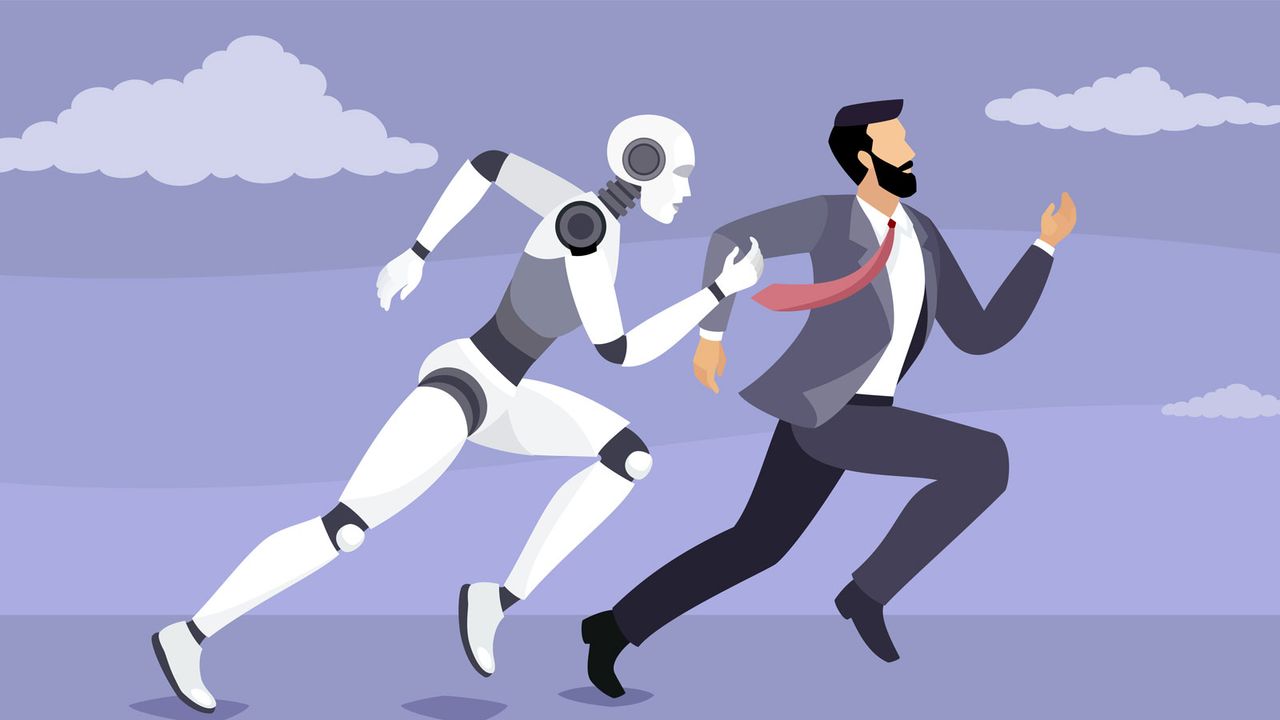
Earlier this month, it was reported that almost 80,000 workers were laid off in the first quarter of 2026, with companies pinning the blame on the rise of artificial intelligence.
Whether through improved task efficiency or cost savings through automation, deployment of AI within the workforce is supposed to be the economically smart decision — even if it didn’t necessarily turn out to be true. But even that story may be hard to tell now, as Nvidia executive Bryan Catanzaro recently commented that, within his team, AI compute power is more expensive than actual workers.
Article continues below
Hey big spender
If you asked Nvidia CEO Jensen Huang how much companies should spend on AI, his answer would probably be at least 50% of what you’re paying your workers. He famously said in March that if an Nvidia engineer who’s paid $500,000 a year weren’t spending at least $250,000 on AI tokens over that same year, he’d be “alarmed.”
In an interview with Axios, Nvidia’s VP of Applied Deep Learning, Bryan Catanzaro, said that within his team, “the cost of compute is far beyond the costs of the employees.” A quick look at an example of the enormity of these costs can be found by looking at available vacancies within the Deep Learning team. One such vacancy for a Senior Software Engineer puts the salary band between $192,000 – $243,000 per-year, which means that employees within that team are racking up high compute costs.
It’s important to note that not every employee in the tech industry will be using AI to the degree that Nvidia employees are, especially those working within the Deep Learning team. Therefore, you cannot reasonably equate their usage of AI models and costs with those of the average worker.
However, within the context of other contemporary tech firms, they are also finding AI spending increasing in 2026. A study in February showed over 80% of companies using AI showed no productivity benefit, while a study from the Harvard Business Review shows AI use is increasing worker burnout rates.
Uber’s CTO said that the company used its annual AI budget in just a few weeks, and the CEO of GetSwan shared that the company spent over $113,000 on AI with a four-person team in just one month. Recently, Anthropic just doubled the expected price tag for individual developers to spend on tokens, from $6 per active day to $13. That equates to around $200 per month per developer. Only its highest-tier subscription would cover that.
Tokenized tolls
However, as AI models get larger and more complex, the hardware required to deploy and use the models does too; this also increases the cost per million tokens served.
Microsoft just announced that it was moving Copilot on GitHub from request-based billing to usage-based billing. In short, that means longer prompts will cost developers more, and longer responses from GitHub will too. Therefore, AI hallucinations go from being an annoyance to having an impact on overall operational costs.
Anthropic’s much-hyped and still-internal Mythos model is reportedly several times more costly per million tokens than Claude Opus 4.7, or even the newer Claude Capybara.
Agentic AI is also raising problems for AI companies, with tools like OpenClaw running constant AI requests, leading to enormous token usage and running up bills that companies might not anticipate.
Scaling up user numbers is one way some AI companies are hoping to fix the problem. OpenAI believes it will lose upwards of 35 million $20 a month subscribers in 2026, but will somehow replace them with 109 million new customers paying the $8 a month ChatGPT Go subscription instead, according to The Information.
Others are trialing limiting availability. Anthropic ran a test recently where some of its premier models weren’t available to Pro subscribers for a limited period. Business Insider suggests data center capacity limits could cause AI companies to restrict model or even service access in some cases, too.
Investors are starting to look for a return on their investments, and that will mean more restrictive, more costly AI for the companies and individuals using it. With AI productivity gains difficult to find, it may be that before long, companies start hiring back human workers for their versatility, efficiency, and cost-effectiveness.

