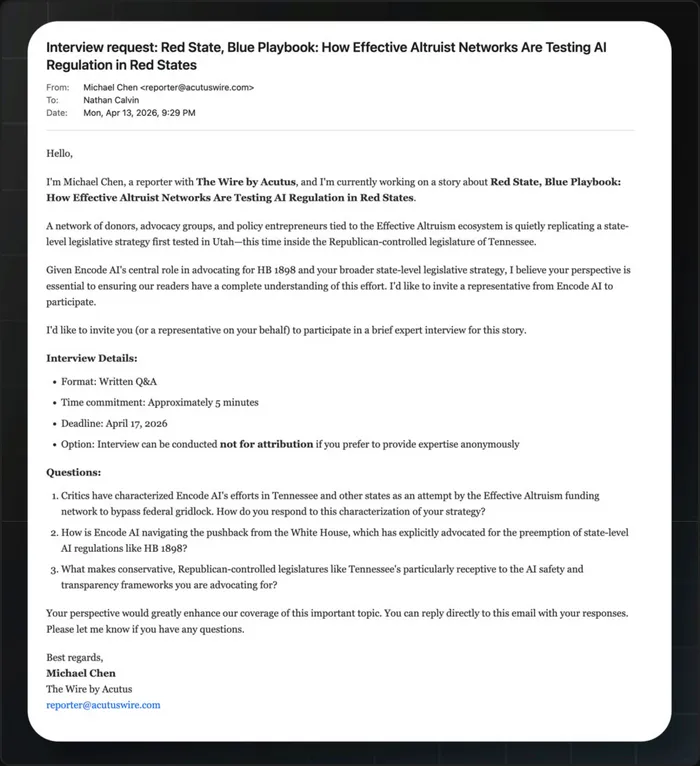
When Nathan Calvin, vice president and general counsel at AI advocacy group Encode, received a press inquiry last week from a reporter named Michael Chen, the email looked slightly off, featuring loaded questions with the only format offered being a written Q&A
Go deeper with TH Premium: AI shortages

Article continues below
Johnston found that the Acutus website is built as a React application, and its client-side JavaScript contains elements of an internal editorial dashboard that absolutely weren’t intended to be public-facing. Fields in the dashboard include “AI Background Context,” described as background material for the AI to draw on when producing questions and writing stories, and a large “Generate Story Draft” button that automates article creation. A separate “Regenerate” function allows operators to re-run the process if the output is unsatisfactory.
The site’s API, accessible at a standard URL in any browser, returned not just finished articles but the full internal record of how each piece was produced. That record includes an automated multi-pass editorial review scored across categories like AP style compliance, quote accuracy, and source verification. Johnston reported that the median time between the first review issue being resolved and the last was 44 seconds, with publication typically following 10 seconds later. Of the 94 stories in the database, 42 carried an automated status of “needs_revision” from the site’s own AI reviewer, but all 42 were published regardless.
The investigation began when Calvin, having received the press inquiry, couldn’t find any record of a “Michael Chen” as being associated with the publication. The email itself, which came from a generic reporters@acutuswire.com email address, was flagged as AI-generated by the detection tool Pangram. The site’s source code also contained an interview infrastructure designed to conduct outreach and gather quotes through automated written Q&A exchanges.
In addition, Johnston traced a connection between Acutus and OpenAI’s political operation. The site had almost no public profile, and its articles had been shared on X only four times, but roughly half of that engagement came from a single person: Patrick Hynes, president of the PR firm Novus Public Affairs.
Novus lists Targeted Victory among its clients. Targeted Victory is the Republican consulting firm whose CEO, Zac Moffatt, co-founded Leading The Future, a $125 million super PAC backed by OpenAI president Greg Brockman and venture capital firm Andreessen Horowitz. The super PAC launched in August 2025 with the stated goal of opposing state-level AI regulation and supporting pro-AI candidates.
According to Johnston, Hynes appeared as a quoted source in an Acutus article, praising a New Hampshire governor’s housing policy on behalf of Novus, with no disclosure that his firm appeared to be operating the publication that was quoting him.
The article’s angle matched the deregulatory position of the New Hampshire Home Builders Association, a Novus client. The site’s content followed no coherent editorial identity but instead closely mirrored what a PR firm’s client roster might produce, Johnston wrote, with articles favorable to the pharmaceutical industry, the cryptocurrency lobby, and multiple 2026 Republican Senate campaigns appearing alongside pro-AI policy coverage.

Follow Tom’s Hardware on Google News, or add us as a preferred source, to get our latest news, analysis, & reviews in your feeds.

